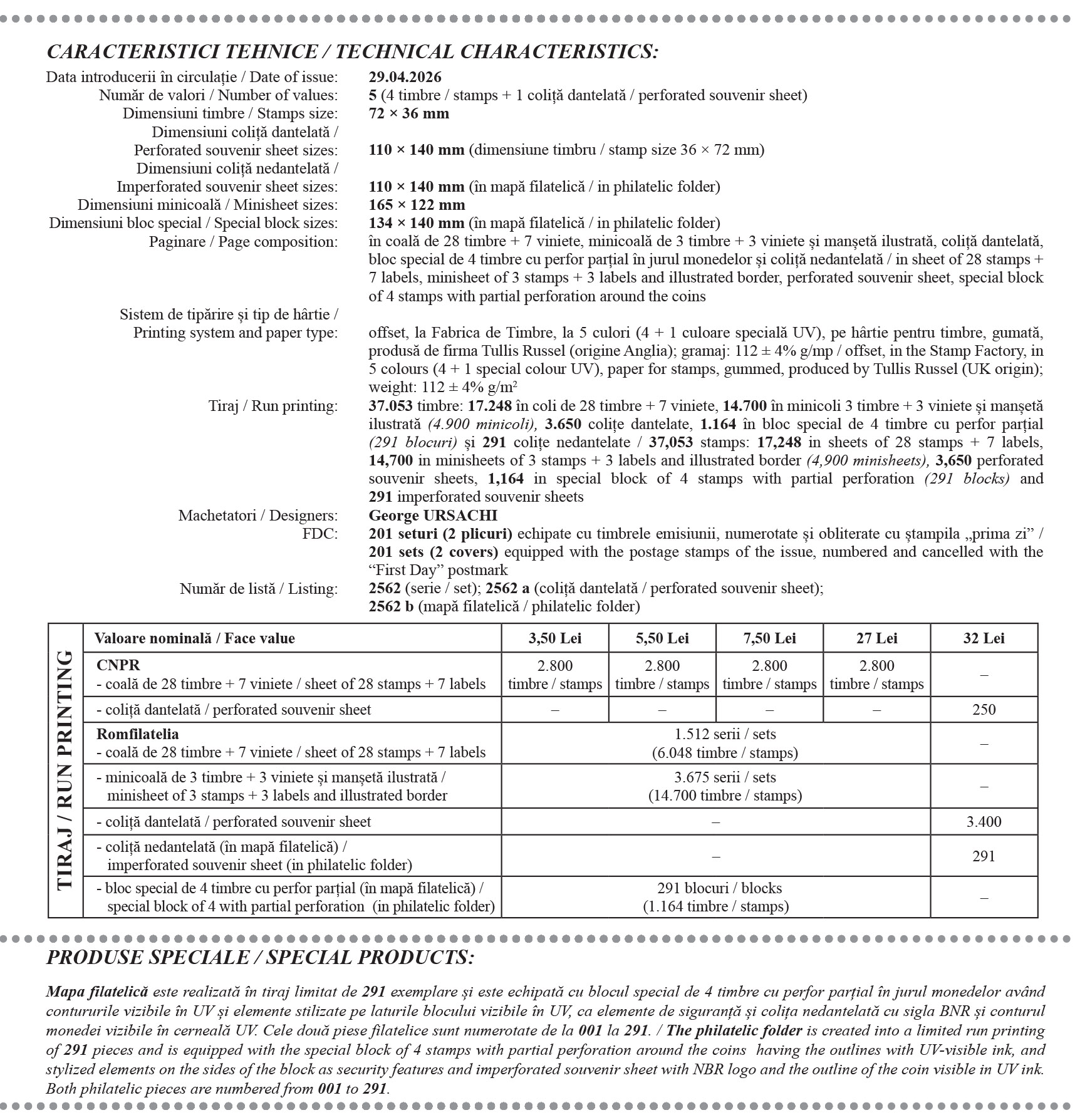
 Romfilatelia and the Romanian Post introduce into circulation on Wednesday, April 29th, 2026 a postage stamp issue with a special historical theme, entitled The Treasure from the Vault of History – The Gold of the National Bank of Romania in Moscow.
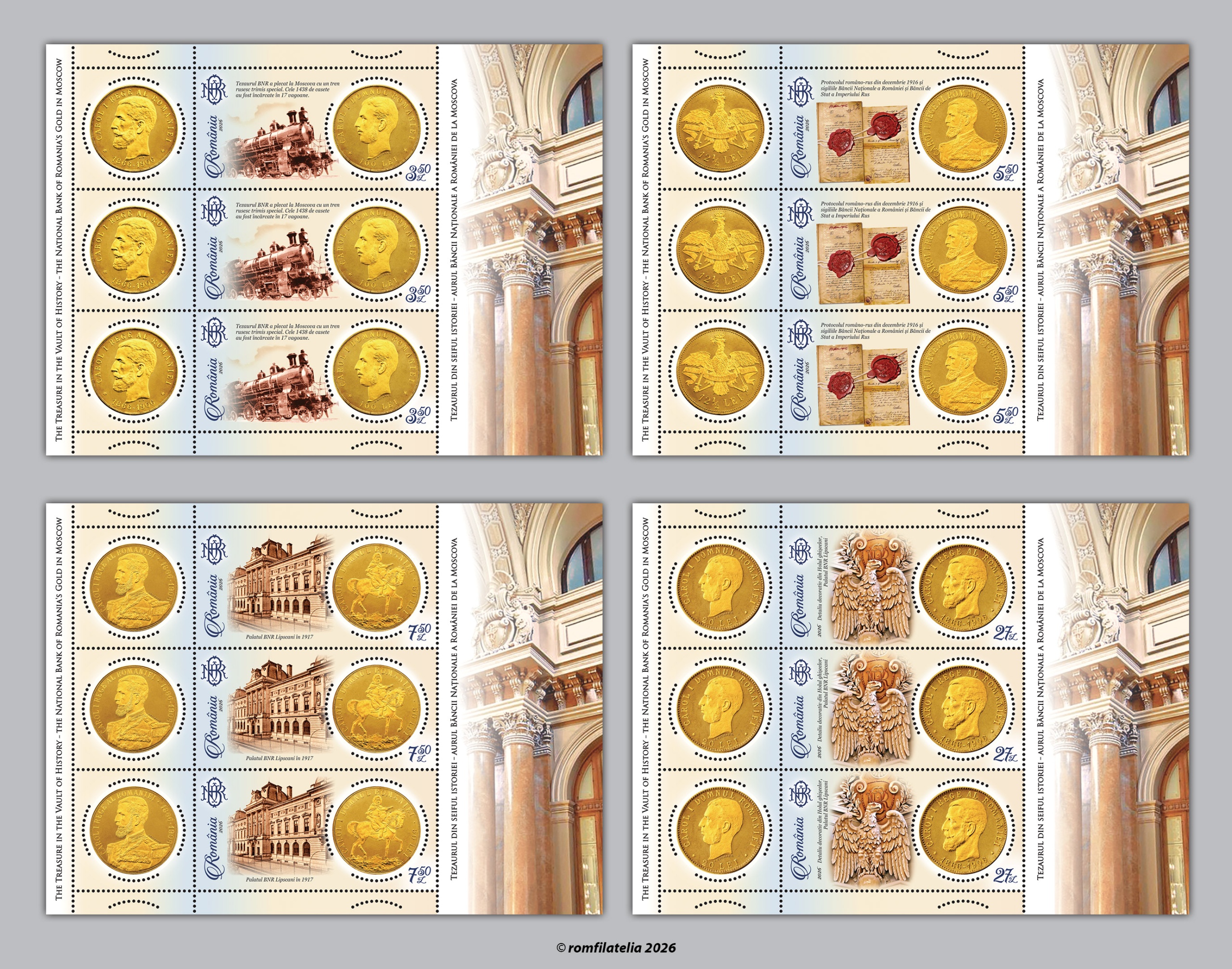
The philatelic elements of the issue consist of four postage stamps depicting the obverses of Romanian gold coins issued in 1906, also known as ‘carols’, after King Carol I, a perforated souvenir sheet, two First Day Covers and a philatelic folder containing a special product in a limited run printing. The issue presents elements visible în UV ink.
The postage stamp with a face value of Lei 3.50 depicts the obverse of a Romanian gold coin worth Lei 100, alongside an image of the Russian train that transported the NBR’s treasure to Moscow. The train carried 1,438 boxes loaded into 17 railcars.
The postage stamp with a face value of Lei 5.50 depicts the obverse of a Romanian gold coin with a face value of Lei 12.50, accompanied by a miniature image of the Romanian-Russian Protocol of December 1916 and the seals of the National Bank of Romania and the State Bank of the Russian Empire.
The postage stamp with a face value of Lei 7.50 features the reverse side of a Romanian coin with a value of Lei 50, accompanied by the Lipscani Palace of the National Bank of Romania, as it appeared in 1917.
The postage stamp with a face value of Lei 27 depicts the obverse of a Romanian gold coin with a value of Lei 20, associated with a decorative detail from the Hall of Counters, Lipscani Palace of the National Bank of Romania.
The souvenir sheet of the issue features, on the postage stamp with a face value of Lei 32, the obverse of a Romanian coin bearing the effigy of Carol I issued in 1870, associated with a reference to the European Parliament Resolution adopted in 2024 regarding the return of the Romanian treasure. The design of the souvenir sheet depicts an interior of the NBR Palace.
One of the First Day Covers features an architectural detail of the façade of the Lipscani Palace of the National Bank of Romania, while the second cover depicts the first page of the Romanian-Russian protocol (Iași, December 14th, 1916) and the inventory of the treasure (Moscow, February 1917).
The history of the National Bank of Romania’s Treasure in Moscow began during World War I, after Romania joined the Entente in August 1916. The Romanian Army was forced to fight on two fronts, which allowed the Central Powers’ troops to occupy two-thirds of Romania’s territory, including the capital, Bucharest. All the institutions of the Romanian state were relocated to Iași.
The risk that the entire country might be occupied by the armies of the Central Powers led the Romanian Government to evacuate the Romanian Treasure to Moscow, given that Russia was the only allied country with which Romania shared a common border, while German submarines were already operating in the Black Sea. The family ties between Queen Marie and Tsar Nicholas II helped facilitate this decision.
The gold reserve (stock) of the National Bank of Romania, weighing 91.5 tonnes of fine gold (coins and bullion), Queen Marie of Romania’s jewellery, and significant historical and cultural assets were evacuated to Russia in two stages, in December 1916 and August 1917. The Imperial Russian Government, and subsequently the Russian Provisional Government, guaranteed the security of the transport, the storage, and the return of all the assets to Romania, these guarantees being clearly set out in the protocols signed by the governments of the two countries. Following their rise to power in Russia, the Bolsheviks seized Romania’s Treasure held in Moscow (January 1918). Although the Soviet Government returned part of Romania’s historical and cultural assets in 1935 and 1956, the gold reserve of the National Bank of Romania has not been returned.
All the protocols regarding the transfer of the NBR Treasure to the Russian side are still preserved today, in their original form, at the National Bank of Romania, with the file containing them having been passed from one governor to the next for over a century. The authenticity of these documents has also been recognized by Russian experts within the Joint Romanian-Russian Commission for the Study of Issues Arising from the History of Bilateral Relations, established pursuant to the Joint Declaration of the Romanian and Russian Foreign Ministers (2003).
Starting in 2023, the National Bank of Romania announced a new approach, namely that of a valid, legal, and enforceable claim against Russia. On this occasion, Governor Mugur Isărescu noted that the issue of the NBR’s Treasure in Moscow ‘remains the only case in which the monetary gold reserve has been entrusted with proper documentation and with all the depositary’s guarantees that it will be returned at any time upon the owner’s request, yet subsequently these obligations, in accordance with all international norms and customs, were not honoured.’
In March 2024, the National Bank of Romania opened the exhibition The Gold Treasure of the National Bank of Romania sent to Moscow and never returned – a claim older than a century, at the European Parliament’s Brussels headquarters, and during the plenary session of the European Parliament on March 14th, 2024, the Resolution on the return of Romania’s national treasure unlawfully appropriated by Russia was adopted by a large majority. The inclusion of the issue of the NBR’s treasure in Moscow on the European political agenda entitles the NBR to continue, with cautious optimism, its efforts to recover this claim.
Romfilatelia thanks the specialists at the National Bank of Romania for the documentary support they provided in the development of this postage stamp issue.