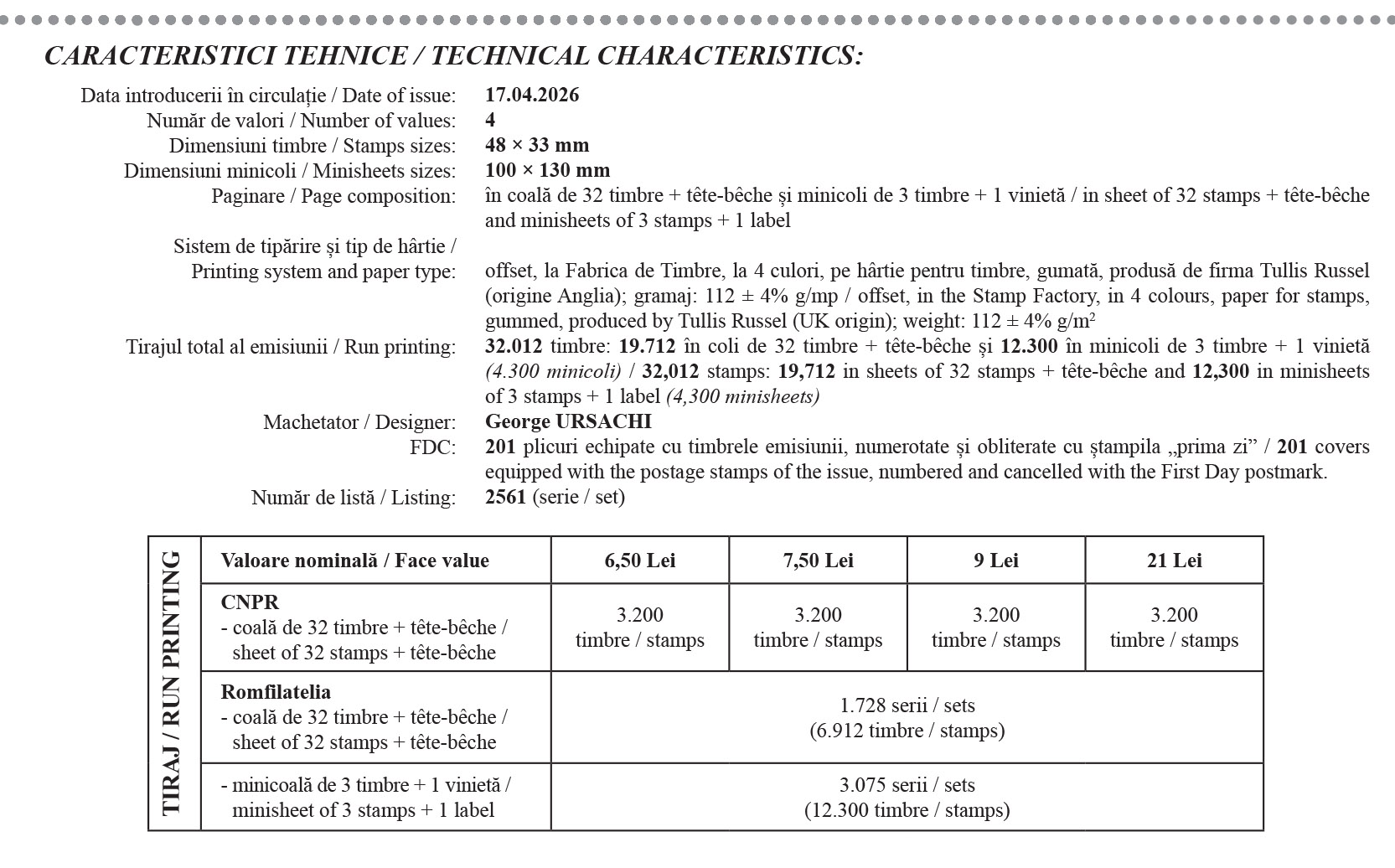
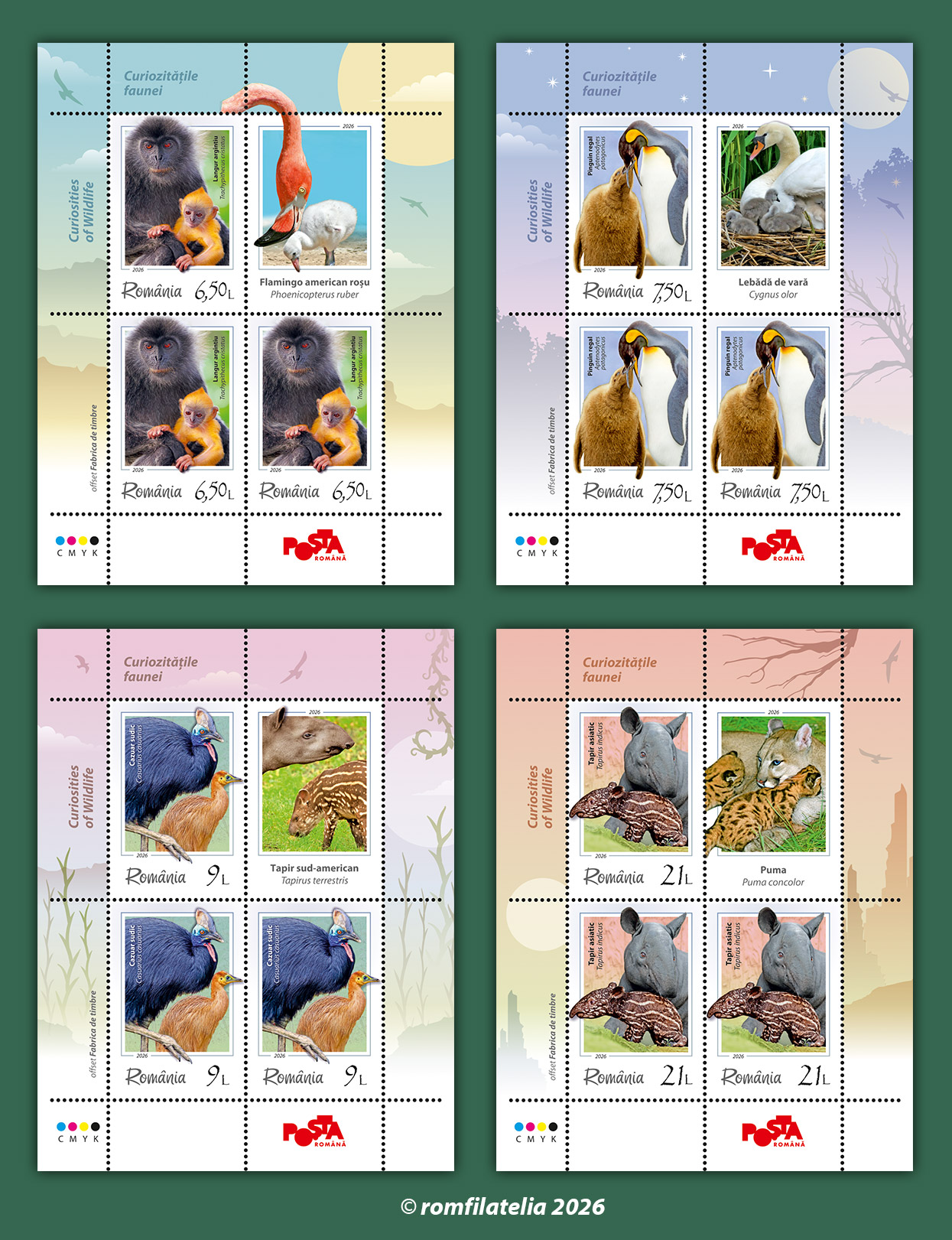
 Romfilatelia continues its series of postage stamp issues dedicated to Fauna and introduces into circulation, on Friday, April 17th this year, a thematic issue entitled Curiosities of Wildlife.
The issue, which consists of four postage stamps and a First Day Cover, is dedicated to some curiosities from the animal world – specifically, situations in which the young of certain animals differ significantly in coloration from the adults.
In some species, this reflects the need to better camouflage the young, who are more ‘helpless’ than adults, move more slowly, and cannot defend themselves.
Thus, cygnets are grey, later turning brownish, rather than displaying the adult’s bright white plumage, which makes them harder to spot among the reeds; flamingo chicks are greyish-white, in contrast to the adult’s pink or red plumage (which is determined by the intake of carotenoid pigments from their diet).
In the case of the southern cassowary – Casuarius casuarius (face value of Lei 9), a large flightless bird – the chicks are initially streaked lengthwise with brown and yellowish feathers, then become uniformly brownish-yellow (as illustrated on the stamp), and eventually acquire the adult’s black plumage (which also features a distinctive casque and red, turkey-like wattles).
Tapirs, large mammals, also have – when young – a dark brown coat marked with longitudinal white stripes. This longitudinal striped pattern provides camouflage among grasses, branches and shoots, helping to break up the outline of the animal as it moves through such environments. Tapirs lose this pattern as they mature, the adult being uniformly brown (in the case of the South American tapir), or black with a large white area across the back and rump in the case of the Asian tapir – Tapirus indicus (face value of Lei 21).
In the puma, a large felid native to the Americas, the young (cubs) likewise display a pattern of brown spots on a beige background, serving the same purpose of camouflage; this pattern disappears in adulthood, being replaced by a uniform greyish-beige coat.
There are also species in which the difference between the coloration of the adult and that of the young serves a purpose other than camouflage.
In the silvered langur – Trachipitecus cristatus (face value of Lei 6.50), a monkey that lives in groups of around 10 – 40 individuals – the adult is silvery-grey (hence the name), but the young, while being carried on its mother’s chest, is a vivid orange colour, which signals from a distance to the other members of the langur group that there is a female with a baby here, requiring assistance and increased protection.
In the king penguin – Aptenodytes patagonicus (face value of Lei 7.50), the chicks are covered in thick, long, brown down, which primarily serves as thermal insulation during the long periods when they wait for their parents to return with food. This down is not waterproof, and as the chicks grow and begin to swim, it is replaced by the adult’s short, dense, waterproof plumage, with its characteristic ‘tuxedo’ pattern accented with orange. Thus, one might say that the penguin chick wears a ‘fur coat,’ while the adult wears a ‘wetsuit’.
Finally, there are also cases in which the colouring of the young is incidental rather than a useful trait. In the red kangaroo, the male is reddish and the female grey, while the young is more reddish or greyer depending on its sex; however, the image on the souvenir sheet captures a case in which the joey is white – an instance of albinism or possibly hypomelanism, mutations that occur extremely rarely. Such an animal is particularly appealing to human observers, who appreciate something a bit out of the ordinary. However, a white joey is easier for predators to spot, reducing its chances of survival in the early stages of life.
Romfilatelia thanks Senior Scientific Researcher Grade I Luis Ovidiu Popa, Director of the ‘Grigore Antipa’ National Museum of Natural History and museum curator Alexandru Iftime, Ph.D., for the specialist consultancy provided in the development of this postage stamp issue.