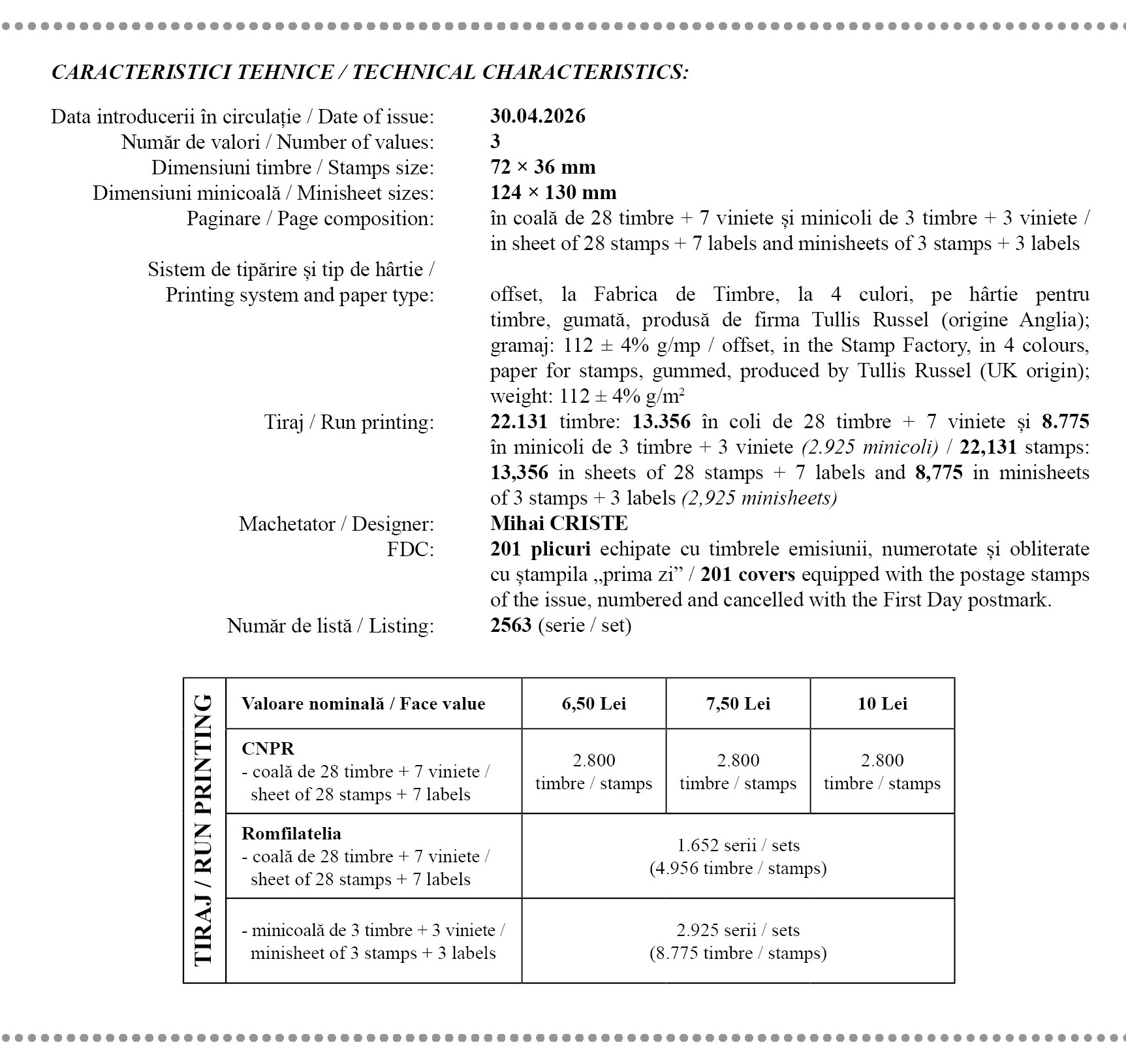
 Romfilatelia and the Romanian Post introduce into circulation on Thursday, April 30th this year the philatelic issue entitled Romanian Tourist Attractions, inviting collectors to take an imaginary journey through our country restored with suport from European funds.
The issue consists of three postage stamps, a First Day Cover and a philatelic folder with special products with limited run printing and offers a unique way to explore our country’s architectural treasures and cultural heritage.
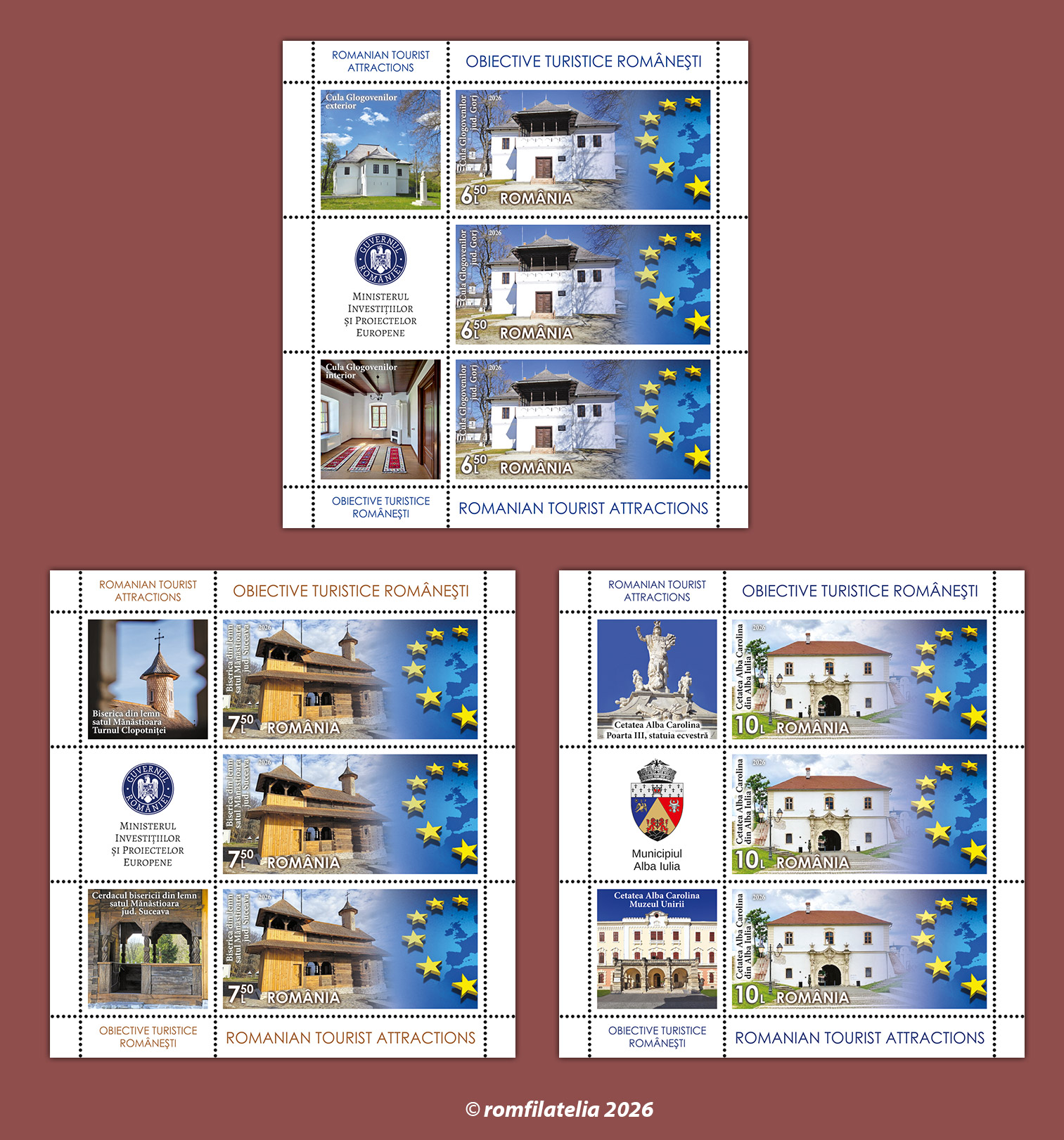
On the postage stamps of the issue are depicted Romanian tourist attractions restored with support from European funds managed by the Ministry of Investments and European Projects (MIEP).The stamp with the face value of Lei 6.50 features Cula Glogovenilor (Glogoveni Tower House), in the village of Glogova, Glogova commune, Gorj County.
A representative monument of fortified architecture in Oltenia, the Glogoveni Tower House in the village of Glogova preserves the memory of the old Glogoveni boyar family. Built in the 17th – 18th centuries, the structure combines residential and defensive functions, featuring a massive cellar, thick walls, loopholes and a porch with wooden columns. The tower house forms part of the valuable historical heritage of Gorj County and illustrates a rare type of Romanian architecture, evoking the history and charm of the Romanian village.
The project aimed to consolidate, restore and enhance the Glogoveni Tower House, a fortified structure of outstanding historical importance, as a tourist attraction.
On the stamp with the face value of lei 7.50 is depicted the wooden church dedicated to the “Entry of the Mother of God into the Church” and the “Transfiguration of the Lord,” located in the village of Mănăstioara, Udești commune, Suceava County, and administered by the Monastery of “Saint John the New of Suceava,” is a historical monument dated to the 18th century. The archaeological record places it to the west of the village, in the Plăvălari forest area.
The restoration works were carried out with financing provided through the National Recovery and Resilience Plan (NRRP). The interventions aimed at the restoration, consolidation, and enhancement of the monument, contributing to the preservation of cultural heritage and its valorisation for future generations.According to the Archdiocese of Suceava and Rădăuți, the project aimed to preserve cultural heritage and increase the tourist appeal of the rural area.
The Alba Carolina Citadel in Alba Iulia (featured on the stamp with the face value of Lei 10) is one of the most impressive Vauban-style fortifications in Eastern Europe and a successful example of cultural heritage restoration through the use of European funds.
The citadel was built in the 18th century, during Habsburg rule, serving a strategic defensive role. Over time, it became a symbol of national unity, as it was the place where the Union of Transylvania with Romania was proclaimed on December 1st, 1918.
Between 2009 and 2015, the Alba Carolina Citadel underwent an extensive restoration process, largely financed through European funds (Regional Operational Programme). The project included: restoration of the bastions and fortified walls, rehabilitation of the monumental gates (especially the Third Gate), the arrangement of pedestrian areas and tourist infrastructure, modern architectural lighting, and the creation of tourist routes and cultural areas.
European funds were essential for preserving the historical heritage, developing local tourism, revitalising the city’s economy, and creating jobs.
Făgăraș Fortress, depicted on the First Day Cover, is undergoing phased rehabilitation with the support of European funds, particularly through the Regional Operational Programme. The works have included the restoration of the walls, bastions and interior spaces. The aim has been to preserve the monument and to develop tourism. Today, the fortress is an important cultural and tourist attraction in Romania.
The rehabilitation of Făgăraș Fortress is an important example of the enhancement of historical heritage through non-repayable European funding, carried out in several stages, beginning in 2015 and continuing to the present day.
Funding was provided through the 2014–2020 Regional Operational Program (ERDF) and the 2021–2027 Central Region Program.
Romfilatelia thanks the representatives of the Ministry of Investments and European Projects, Mr. Nicolae Pepene, Director of the Brașov County Museum of History, Ms. Ioana Gabriela Rustoiu, museum curator at the National Museum of the Union in Alba Iulia, Alba Iulia City Hall, Glogova commune town hall, Gorj county, to the Archdiocese of Suceava and Rădăuți and the photographer Petru Palamar for the documentary support provided in the development of this postage stamp issue.