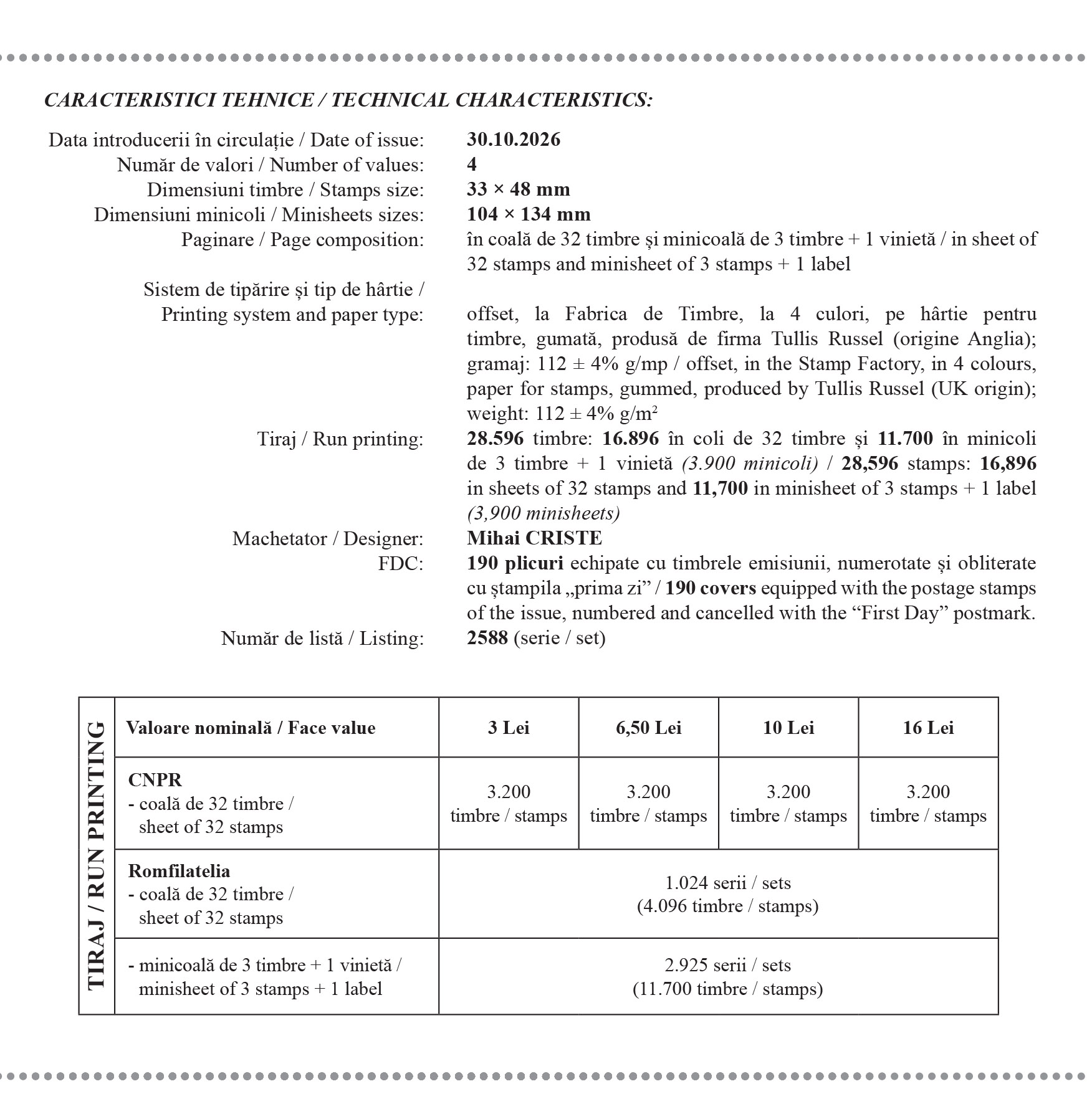
 Romfilatelia and the Romanian Post introduce into circulation, on Friday, October 30th, 2026, the postage stamp issue entitled Masks.
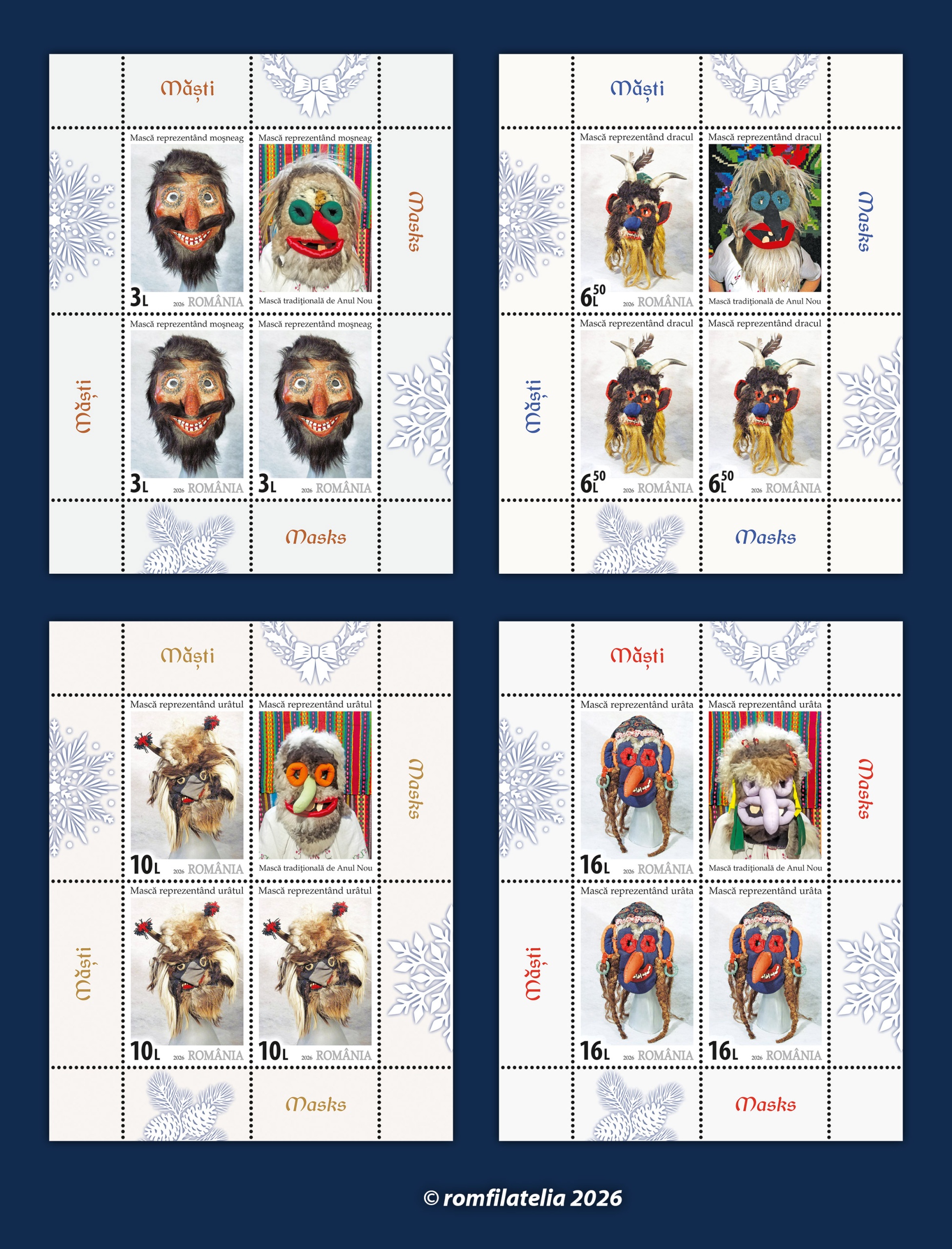
The philatelic issue, consisting of four postage stamps and a First Day Cover, illustrates masks from the heritage of the National Museum of the Romanian Peasant. Within the typology of characters suggested by the facial features so ingeniously shaped by their makers, the following masks are featured: Moșneag (Old Man), Drac (Devil), Urât (Ugly Man) and Urâtă (Ugly Woman), as well as the mask-costume for the ritual of the Capra (Goat), depicted on the First Day Cover.
The ‘Old Man’ mask, depicted on the postage stamp with the face value of Lei 3, belongs to the valuable collection of ceremonial objects and folk masks. This type of anthropomorphic mask represents a symbolic figure of the old man and is traditionally used in New Year processions and rituals or in seasonal ceremonies to drive away evil spirits and bring abundance.
Items of particular importance in this category, coming from the museum’s collections, are classified as part of the national cultural heritage.
The characteristics of the ‘Old Man’ mask are as follows:
• Face piece: It is made of carved wood (often caricaturing the features of an old man) or of shorn sheepskin.
• Physiognomy: The eyes are cut out and sometimes outlined by pyrography or lined with leather for greater expressiveness. The eyebrows are broadly arched to convey astonishment or greed.
• Mouth and teeth: The mouth is cut out, often hemmed or painted red, while the most picturesque element is the teeth made of beans or pieces of wood.
• Hair and beard: These are made of long goat or sheep fur (grey and white in colour).
The old man character embodies folk wisdom combined with satirical humour. During the masked plays of the winter holidays, the old men and old women symbolically represent the ancestors, their role being to purify the space, to censure the community’s vices through ironic retorts and to ensure a fertile passage into the new year.
The characteristics of the ‘Devil’ mask, illustrated on the postage stamp with the face value of Lei 6.50:
• Character typology: The mask belongs to the category of demonic masks (alongside the urâți – the ‘ugly ones’ – or Scaraoschi, the Devil), which play an increasingly important role in the structure of New Year carolling groups.
• Materials and making: They are made of cloth, felt, leather and fur (used for the eyebrows, moustache or beard), with appliqués such as animal horns (cow, ram) and pieces of coloured fabric for the lips and the outline of the eyes.
• Associated costume: In folk tradition, the Devil mask was frequently worn with a sheepskin coat turned inside out, to the back of which a kid goat’s tail was attached.
The ‘Ugly Man’ mask, depicted on the postage stamp with the face value of Lei 10, displays the following details:
• Typology and structure: Anthropomorphic masks depicting male or caricatured characters, consisting of a face piece, a beard and a hat.
• Materials used: The face piece is usually made of sheepskin (shaved around the cheekbones and dyed); the eyes are cut out, often using the perforated bowls of metal spoons or other recycled items; the nose is prominent and applied, while the mouth is outlined with thick lips and teeth made of beans strung on wire.
• Traditional role: In winter customs and plays, as well as in agrarian/community rituals, the ‘ugly’ characters (as opposed to the ‘handsome’ ones) served to reverse social roles and to provoke roars of laughter, but also had an apotropaic purpose (warding off evil spirits or bad luck through their grotesque appearance and noise).
The traditional ‘Ugly Woman’ mask, depicted on the postage stamp with the face value of Lei 16:
Among the props of the New Year folk theatre, this type of mask is conceived as a comic character, with the following visual and structural details:
• Anthropomorphic typology: The mask is usually made as a head mask, completely covering the wearer’s face or head.
• Distinctive elements: It consists of a face piece (the face proper), long locks braided into two plaits (often made of black wool yarn, hemp or fur) and a characteristic headscarf tied at the back.
• Materials used: To make it, craftsmen use pieces of leather, thick fabrics (broadcloth), fur, textile threads and various appliqués of buttons or beads to highlight the character’s garish features.
In masked plays (such as the New Year Procession or the comic scenes from Moldova and Bucovina), the Ugly Woman mask serves to stir up merriment, to mock human flaws and to liven up the atmosphere. From a mythological point of view, these ‘outsider’ or marginal characters of folk sketches symbolise the world of chaos preceding the New Year, which is ritually driven away through noise, dancing and shouting to make way for the clean new year.
The First Day Cover depicts the Goat Mask and costume (belonging to the typology of mask-costumes with a ritual, purifying and fertility-bringing role).
Elements of the traditional Goat costume:
• The Wooden Head: Hand-carved from wood, usually fitted with a movable lower jaw (a clattering snout) operated by means of a cord or a lever from the inside to produce the characteristic sound (‘clămpănit’ – clattering). The horns are usually real (goat or ram horns) or carved in wood, and the head is sometimes adorned with mirrors, beads, tassels or strips of coloured fabric.
• Body / Covering: The person wearing the mask is concealed beneath a lăicer (a traditional woven rug), a macat (a heavy woven blanket), or a thick piece of cloth.
The Goat play is often accompanied by other masked characters or folk types from the village heritage: the Old Man, the Old Woman, the Devil, the Doctor (who ‘heals’ the Goat when it ‘falls’ during the performance) and the musicians.
Romfilatelia thanks Mr Virgil Ștefan Nițulescu, General Manager, and the documentation team of the National Museum of the Romanian Peasant for the documentary and photographic support provided in the development of this postage stamp issue.