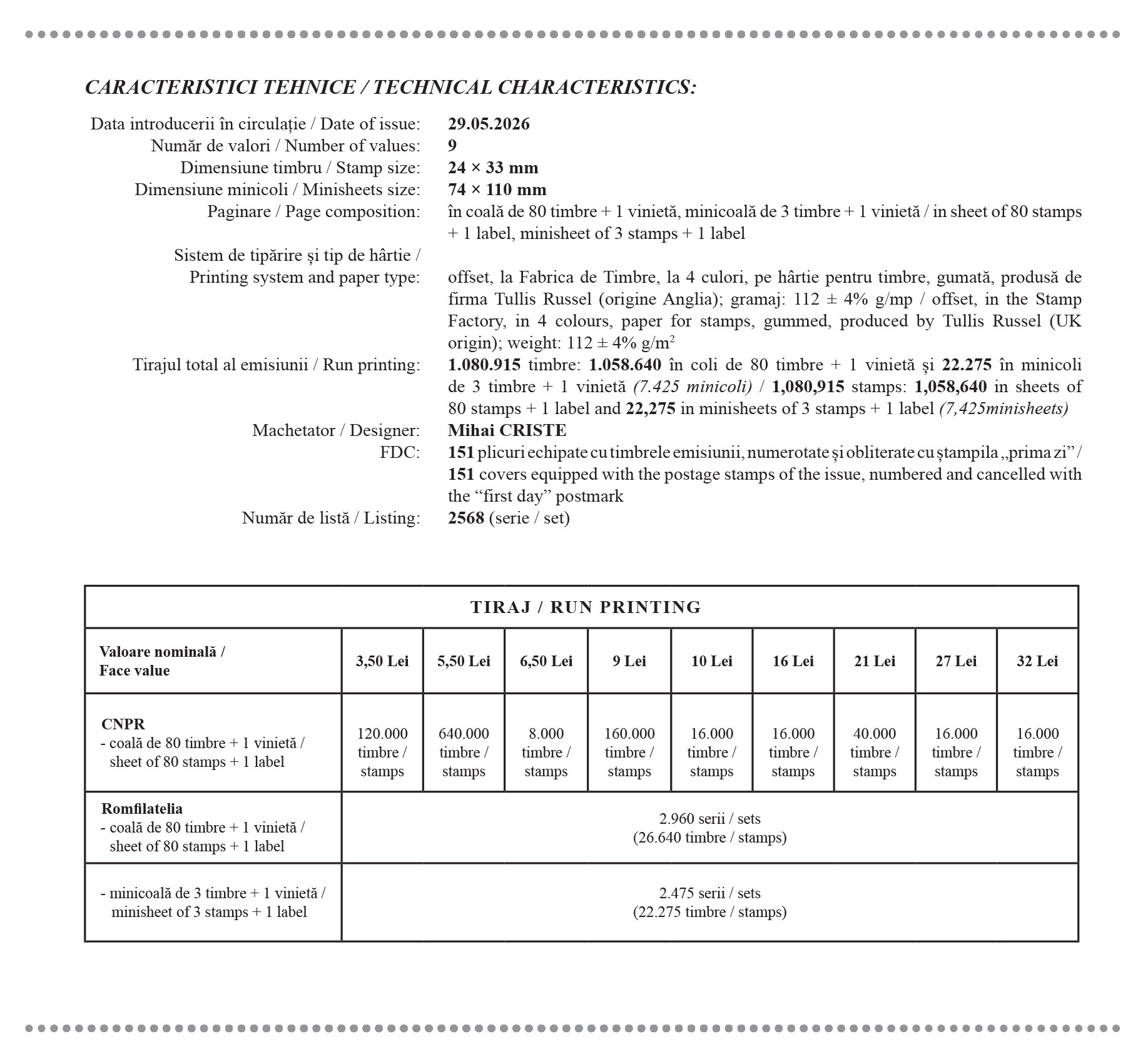
 Romfilatelia and the Romanian Post introduce into circulation on Friday, May 29th, 2026, the issue of regular postage stamps on a theme reflecting the tradition of folk art, entitled Floral and Zoomorphic Motifs in Romanian Folk Art consisting of nine postage stamps and a First Day Cover.
Floral and zoomorphic motifs represent a rich symbolic universe in Romanian folk art, reflecting the sacred bond between people and nature. These stylised symbols adorn traditional costumes, ceramics, textiles, furniture, painted eggs, glass icons, and wooden objects, with each form conveying a story or an ancient belief.
Floral motifs are among the most widespread elements in Romanian folk art. They symbolise beauty, life, fertility and the rebirth of nature.
Animals are often stylized rather than drawn realistically. Folk artists simplify the lines and repeat geometric shapes to create harmonious decorative patterns.
In traditional Romanian culture, ornaments did not serve merely an aesthetic purpose. They were believed to protect the wearer or the household, bring good fortune and fertility, and preserve the connection with ancestors and nature.
For this reason, many patterns were passed down from one generation to another and were specific to certain regions.
Romanian folk art thus preserves a true ‘language of symbols’ in which every flower or animal has its own particular meaning.
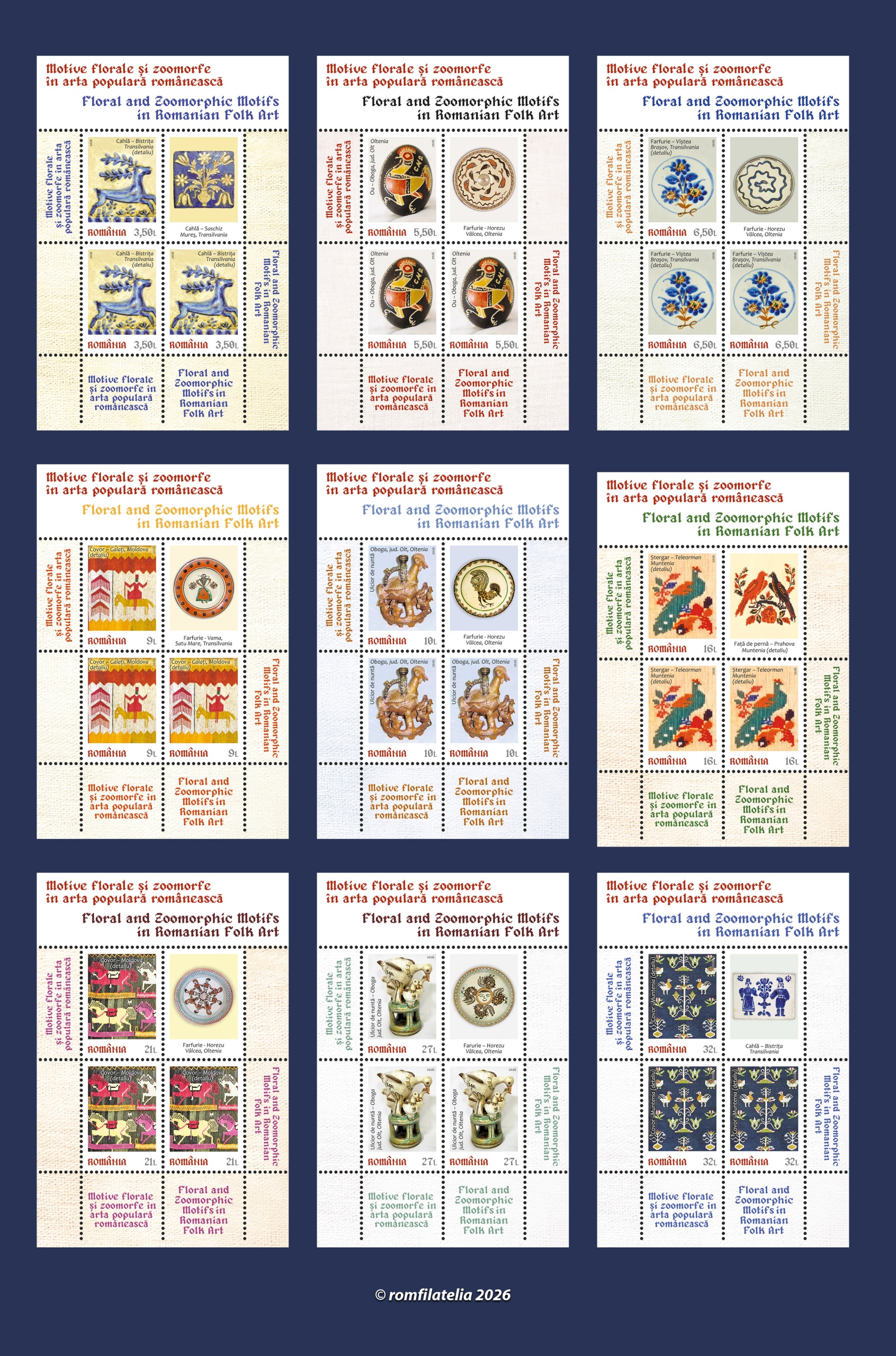
The postage stamp with a face value of Lei 3.50 illustrates Ceramic Tile – Bistrița, Transylvania, featuring an ornamental detail depicting a stylised zoomorphic motif, rendered as a stag captured in motion.
The postage stamp with a face value of Lei 5.50 features an Egg – Oboga, Olt County, Oltenia.
The painted egg comes from the Oboga area and is decorated with a stylized avimorphic motif depicting a rooster.
The postage stamp with a face value of Lei 6.50 illustrates a Plate – Viștea, Brașov, Transylvania, featuring an ornamental detail composed of stylised phytomorphic motifs arranged in the form of a floral bouquet made up of three flowers and leaves enclosed within a circle.
The postage stamp with a face value of Lei 9 depicts Carpet – Galați, Moldova featuring an ornamental detail composed of stylised anthropomorphic, zoomorphic and phytomorphic motifs, represented by the figure of a male character riding a horse and the tree motif rendered in the form of a fir tree.
The postage stamp with a face value of Lei 10 illustrates a Wedding Jug – Oboga, Olt County, Oltenia, of avimorphic form, representing a stylised hen surrounded by chicks. The ensemble is arranged on a circular ring-shaped support sustained by small pillars. The plumage decoration is suggested through stylised and embossed motifs harmoniously integrated into the ornamental composition.
The postage stamp with a face value of Lei 16 features an ornamental detail from a Traditional Towel – Teleorman, Muntenia.
It consists of stylized plant and bird motifs, depicted as leafy branches, flower buds, and a peacock shown in full profile, arranged in a symmetrical composition.
The postage stamp with a face value of Lei 21 depicts an ornamental detail from a Carpet – Moldova, composed of zoomorphic, avimorphic, insect-like and geometric motifs arranged in a symmetrical composition. The decoration includes stylised representations of horses, birds and butterflies, rhythmically arranged in ornamental registers and framed by zigzag lines.
The postage stamp with a face value of Lei 27 illustrates a Wedding Jug – Oboga, Olt County, Oltenia, of avimorphic form, representing a stylised stork flanked by three chicks. The ensemble is arranged on a support consisting of two circles (rings) joined by four small pillars. The plumage decoration is suggested through interconnected semicircular motifs, while the legs and the support are ornamented with polychrome wavy lines. Inscription: OBOGA O.G.F. C-tin.
The postage stamp with a face value of Lei 32 features an ornamental detail from a Carpet – Muntenia, composed of stylised phytomorphic and avimorphic motifs arranged in a symmetrical decorative composition. The ornamentation includes a vegetal garland, representations of birds and flowering trees depicted in flower pots.
Romfilatelia thanks Mr. Eugen Țepeș Stroia, museum curator at the ‘Dimitrie Gusti’ National Village Museum, for the documentary and photographic support provided in the development of this postage stamp issue.