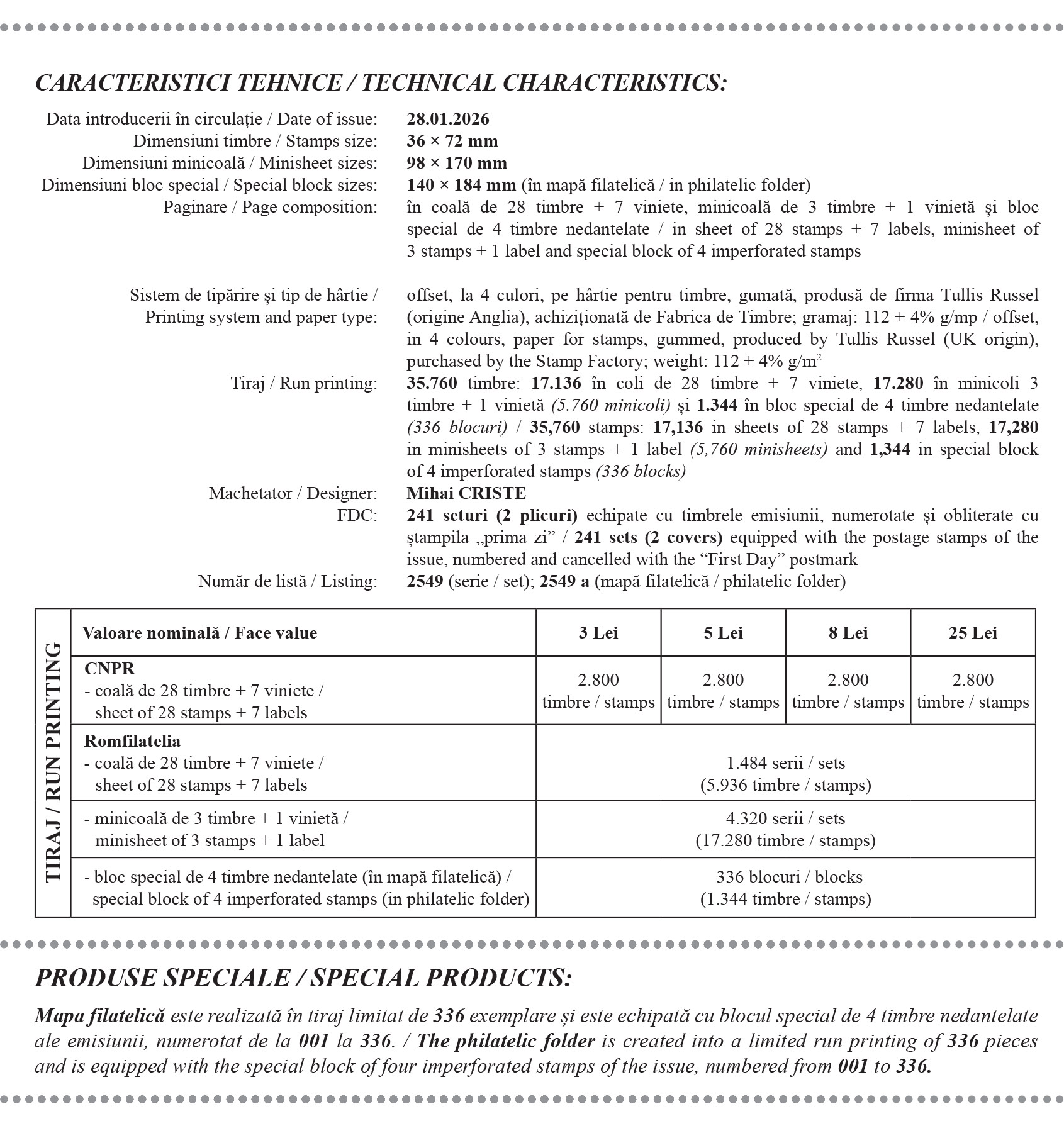
 Romfilatelia and the Romanian Post introduce into circulation on Wednesday, January 28th this year a new postage stamp issue dedicated to Art, entitled The Seasons in the Light of Stained Glass. Sever Frențiu, which presents artistic creations from a valuable collection of stained glass from the heritage of the Administrative Palace in Arad.
The imposing building representing the Administrative Palace of Arad was constructed between 1872 and 1875, in Neo-Renaissance style, based on the plans of the Pest-based architect Ödön Lechner.
This building was designated to serve as the town hall from the very moment the decision to construct it was made. An architectural gem, with a quadrangular, U-shaped layout, this veritable ‘Palazzo del Municipio’ reflects the capabilities and determination of the citizens to keep pace with European modernization.
The majestic stained-glasses in the staircase hall of the Administrative Palace in Arad, created by Sever Frențiu, dominate the interior of the building.
Born on November 15th, 1931, in Săcuieni, Bihor County, Sever Frențiu graduated from the ‘Ion Andreescu’ Institute of Fine Arts in Cluj. He was a founding member and president of the Arad branch of the Union of Visual Artists of Romania. Here, he organized the city’s first art gallery, called ‘Alfa,’ which included an exhibition hall and a sales shop for visual art creations such as paintings, ceramics, jewellery, clothing etc.
He regularly participated in art and stage design exhibitions in Romania and abroad. He initially worked as an engraver, then, starting in 1960, he was a stage designer at the State Theatre in Arad.
He died in Arad on November 6th, 1997, at the age of only 66.
He is the artist who created the stained-glass ensembles in the lobby of the Administrative Palace and of the Arad County Library. These are monumental works of genuine artistic value, to the creation of which he devoted four years of his life. In 1977, one hundred years after the inauguration of the building, Sever Frențiu installed original stained-glasses of exceptional beauty on the nine large windows of the Administrative Palace of Arad, a work he entitled ‘The Seasons and the Months of the Year’.
A significant portion of the glass used in these stained glasses was brought by Sever Frențiu from Italy, from Murano, the small island in the Venetian Lagoon renowned for its high-value glass objects. The master personally traveled there to select the glass. The glass from Murano is darker in tone; it can be seen in the blue areas placed above the figures, giving them a distinctive visual weight. Another part of the glass was produced in Romania.
The leading and firing of the stained-glasses were carried out in a workshop in Timișoara.
The work, of exceptional value, was at the time considered the finest example of stained-glass technique in Romanian contemporary art.
Even today, it enjoys genuine popularity among those who enter the Administrative Palace and, alongside the sumptuous Ferdinand Hall, remains one of the main attractions of both the building and the city of Arad.
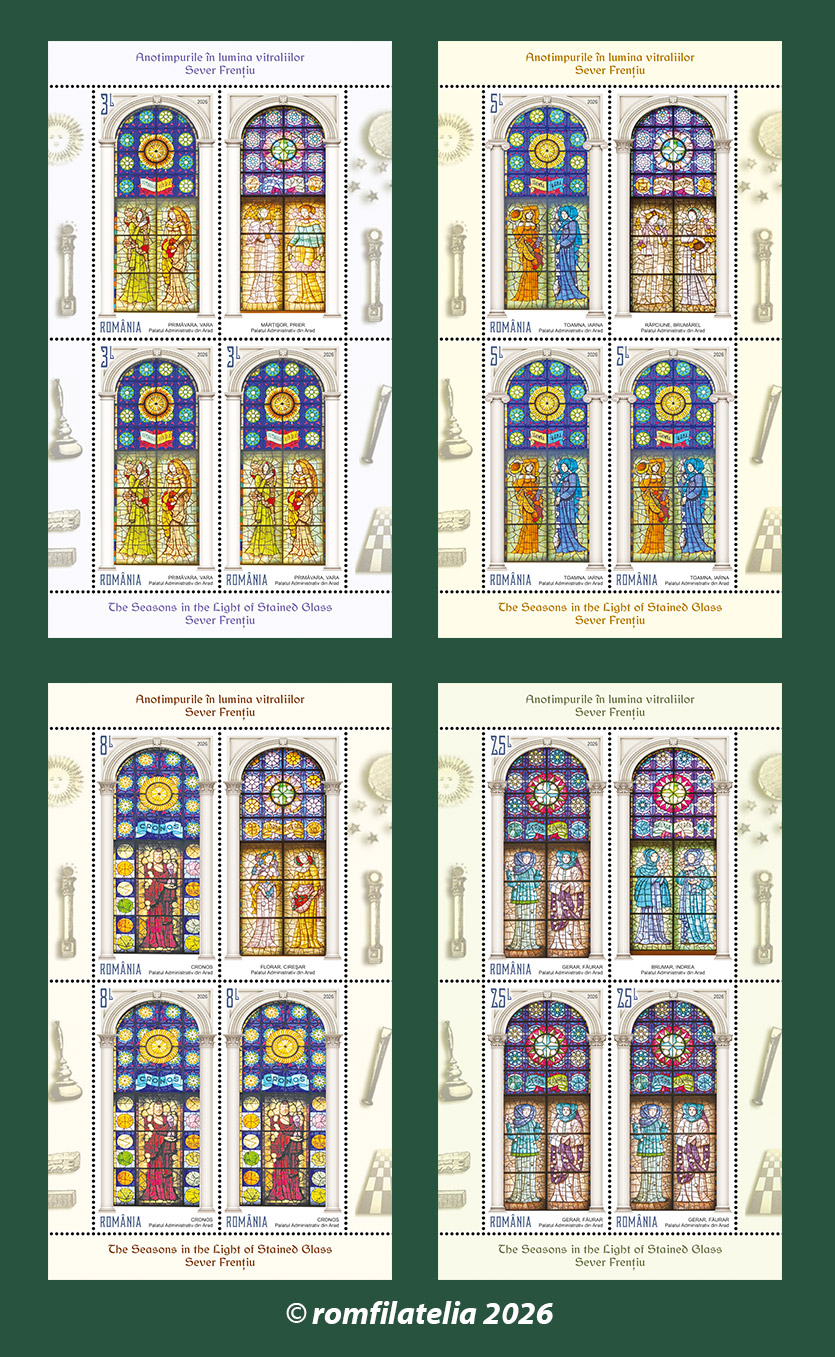
The four seasons, arranged in two panels each, are Spring-Summer and Autumn-Winter, illustrated on the stamps with the face values of Lei 3 and Lei 5.
Four allegorical figures are depicted in pairs, each in the form of a young and beautiful woman, embodying the seasons of spring, summer, autumn, and winter. Their garments are decorated according to the season each symbolizes. The stained-glasses were installed in 1977, one hundred years after the City Hall building was put into use.
When the stained glasses were finally installed in the stairwell of the Administrative Palace in Arad, the result was a shock to everyone. No one expected something so grandiose. It was considered the most beautiful work of stained-glass art in Romania, radically transforming the interior appearance of the building.
At the center of the stained-glasses in the staircase hall of the palace, Sever Frențiu projected himself, embodying Cronos (depicted on the stamp with the the face value of Lei 8), the god of time from Greek mythology, framed by allegorical representations of the four seasons and the twelve months of the year with their traditional popular names.
Comparing the image of Cronos in the stained glass with the portrait of Sever Frențiu, one can observe striking similarities.
On the postage stamp with the face value of Lei 25, the months of January and February are depicted, bearing their traditional popular names Gerar and Făurar – an appropriate choice associated with January, the month in which the issue was introduced into circulation. In the artist’s vision, the image of this stained glass embodies two beautiful women, clad in winter garments, sifting snow over the world.
One of Arad’s urban legends says that the inspiration for the muses of the seasons and months of the year were actually the artist’s former lovers.
One of the First Day Covers depicts the Administrative Palace in Arad (the headquarders of Arad City Hall), while the other shows a detail of a stained glass seen from the inside.
Romfilatelia thanks the representatives of Arad City Hall, the ‘Alexandru D. Xenopol’ County Library in Arad, photographer Daniel Boca and the National Grand Lodge of Romania for their documentary and photographic support in developing this postage stamp issue.