 100 Years of Glory and History in Romanian Boxing
‘Boxing is about embracing your opponent, not destroying him;
it’s not about hatred, but about being smart. It’s about accepting
victory with pride and defeat with dignity.’
Eugen Barbu
An anniversary postage stamp issue dedicated to a sport practiced for millennia by both amateurs and professionals will be introduced into circulation by Romfilatelia and the Romanian Post on Thursday, March 26th this year under the summarizing title ROMANIAN BOXING FEDERATION, 100 YEARS.
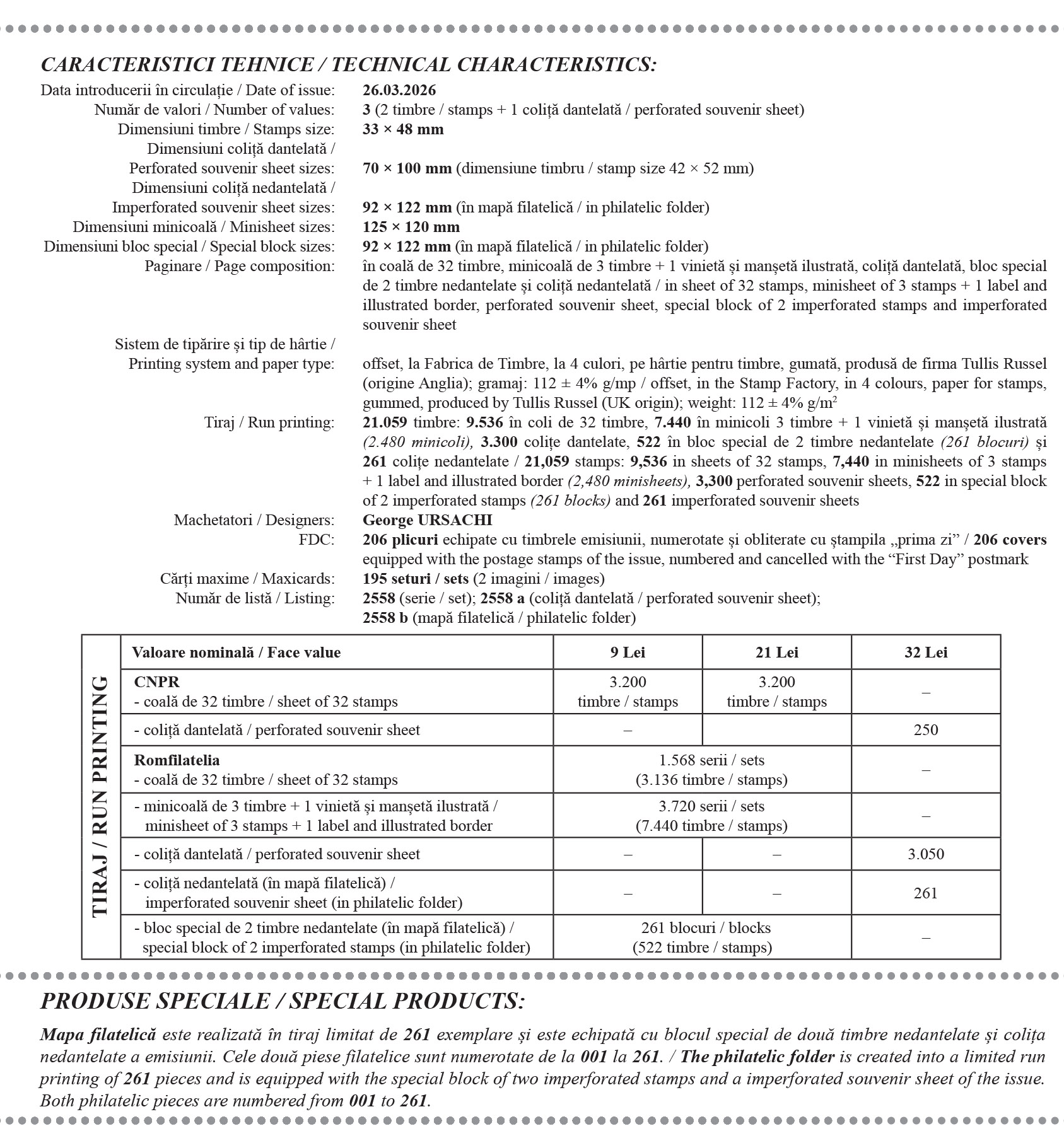
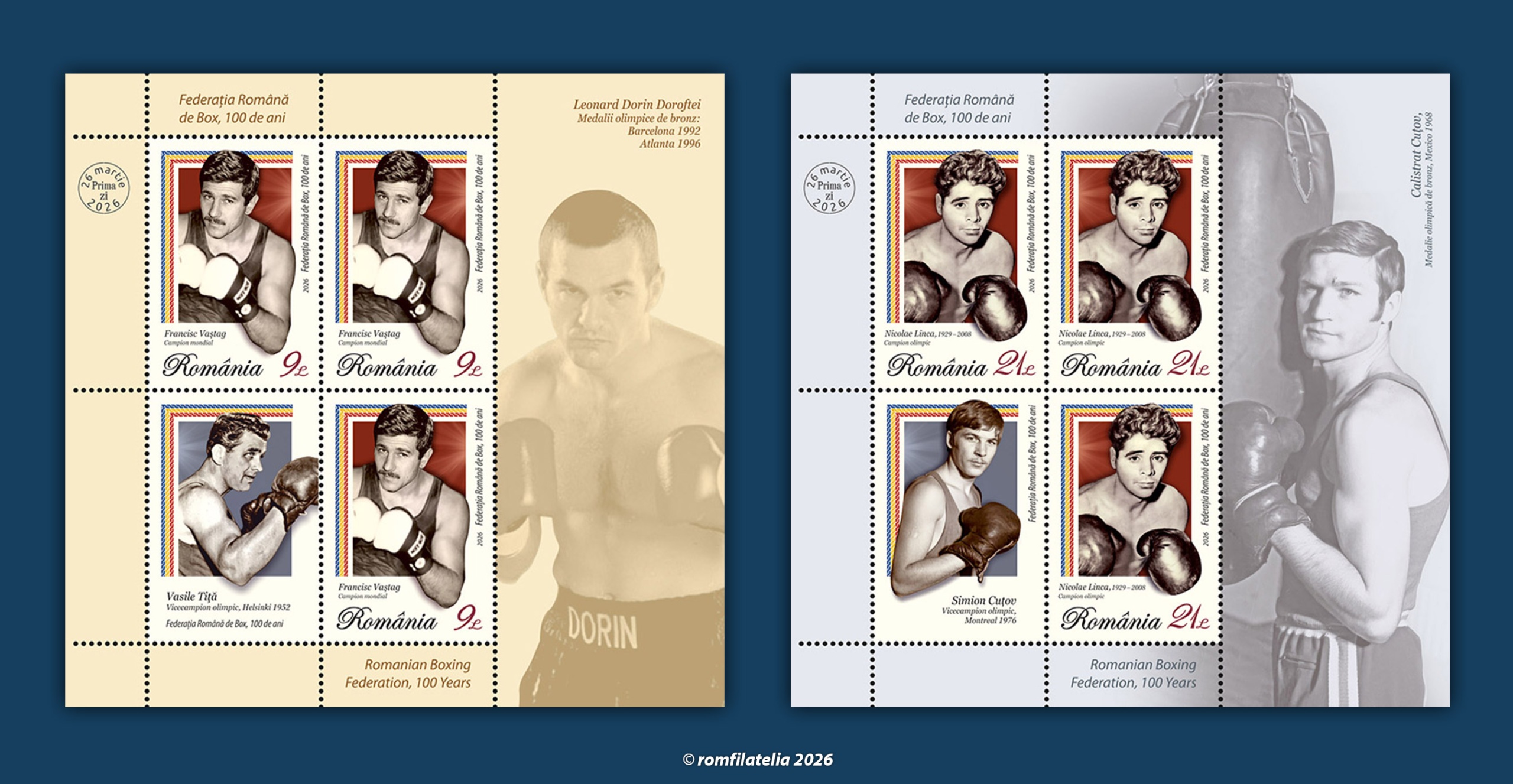
The issue consists of two postage stamps, a perforated souvenir sheet, a First Day Cover, a set of two maxicards for maximaphily enthusiasts and a philatelic folder with special products in limited run printing.
The postage stamp with the face value of lei 21 depicts the image of the Olympic champion Nicolae Linca, who, at the 1956 Melbourne Olympics, won the first Olympic gold medal for Romania, and the postage stamp with the face value of lei 9 presents Francisc Vaștag, a three-time world champion.
The perforated souvenir sheet of the issue, bearing the postage stamp with the face value of lei 32, depicts an image from a boxing match between King Michael I and a schoolmate in the presence of coach Gheorghe Axioti.
It is worth noting that boxing is one of the oldest Olympic sports, having been included in the Olympic Games program in ancient times, in the 7th century B.C.
In particular, boxing has been practiced in an organized manner since the 17th century in England, where the first official amateur matches were held in 1880. Modern amateur boxing was included in the Olympic Games in 1904.
The first school dedicated to boxing was founded by Jack Broughton, who introduced the first written rules, which included the use of boxing gloves.
In Romania, boxing, which was initially practiced in the form of demonstrations in circuses or restaurants, began to take on a more organized structure starting in 1920, following the establishment in March 1920 of the ‘Boxing Club’ by founder Mihai Codruș.
The sport of boxing appeared in Romania at the beginning of the 20th century and experienced a rapid rise from the outset, from the first boxing galas organized in the country by sailors who arrived aboard commercial ships.
On March 26th, 1926, the Romanian Boxing Federation was officially established under the presidency of Nicolae Niculescu-Ianca. The first General Assembly of the Romanian Boxing Federation took place a few days later, on April 2nd, 1926, and that same year, its affiliation with the International Boxing Union (IBU) was confirmed.
In 1930, the international governing body of professional boxing accepted a Romanian boxer as a challenger for a European title for the first time. Lucian Popescu managed to defeat Kid Olivera by retirement, becoming the first Romanian European champion.
In 1952, at the Helsinki Olympics, Romania won its first Olympic medals in boxing, thanks to Vasile Tița (silver) and Gheorghe Fiat (bronze). Since then, Romanian boxing has been a constant presence at every edition of the Olympic Games, bringing Romania 25 medals at the world’s most prestigious competition.
In Melbourne in 1956, Romania won its first Olympic gold medal thanks to Nicolae Linca (light middleweight). At those Games, Romania’s boxing team would go down in history as the ‘golden generation’ – all four of our boxers made it onto the Olympic podium: Linca – gold, winning the final against Ireland’s Friederick Tiedt despite having a fractured right hand; Mircea Dobrescu – silver; Gheorghe Negrea – silver; and Constantin Dumitrescu – bronze.
Since 1985, Romania has become one of the superpowers of world boxing, alongside Cuba and Russia, thanks to a series of elite boxers, including: Francisc Vaștag (three-time world champion), Leonard Doroftei (a legend in both world sports and professional boxing), Marcelică Tudoriu, Daniel Maeran, Dorel Simion, Crinu Olteanu, Marin Simion, Ovidiu Bobârnat, George Lungu, Lucian Bute, Mihai Leu (who made a short list of the world’s professional boxers who ended their careers undefeated), Waldemar Cucereanu, Vasile Nistor, and many others, reaching the 1999 World Championships in the U.S. – with Feri Vaștag as coach this time – to win seven medals, a feat unmatched to this day.
Since 2000, Romania has also been among the pioneers of women’s boxing competitions, with our ‘iron ladies’ achieving impressive performances at European and world levels through: Camelia Negrea, Mihaela Lăcătuș, Florea Liheț, Adriana Hosu, Steluța Duță, Luminița Turcin, and in recent years through Lăcrămioara Perijoc, Amalia Niță, Claudia Nechita, and Andra Sebe.
One hundred years after the official establishment of the Romanian Boxing Federation, under the presidency of Vasile Cîtea, Romanian boxing remains among the elite sports disciplines in Romania, gradually regaining its former prestige. This is also evidenced by the 21 European medals won by Romanian boxers over the past year.
100 years of boxing, glory, and history – and the story continues…
Romfilatelia thanks the representatives of the Romanian Boxing Federation for their assistance granted in the documentation for this postage stamp issue, as well as the representatives of the Household of Her Majesty Margareta, the Custodian of the Romanian Crown, the Romanian Olympic and Sports Committee, and the Stamp Factory, a branch of the Romanian Post, for their cooperation.