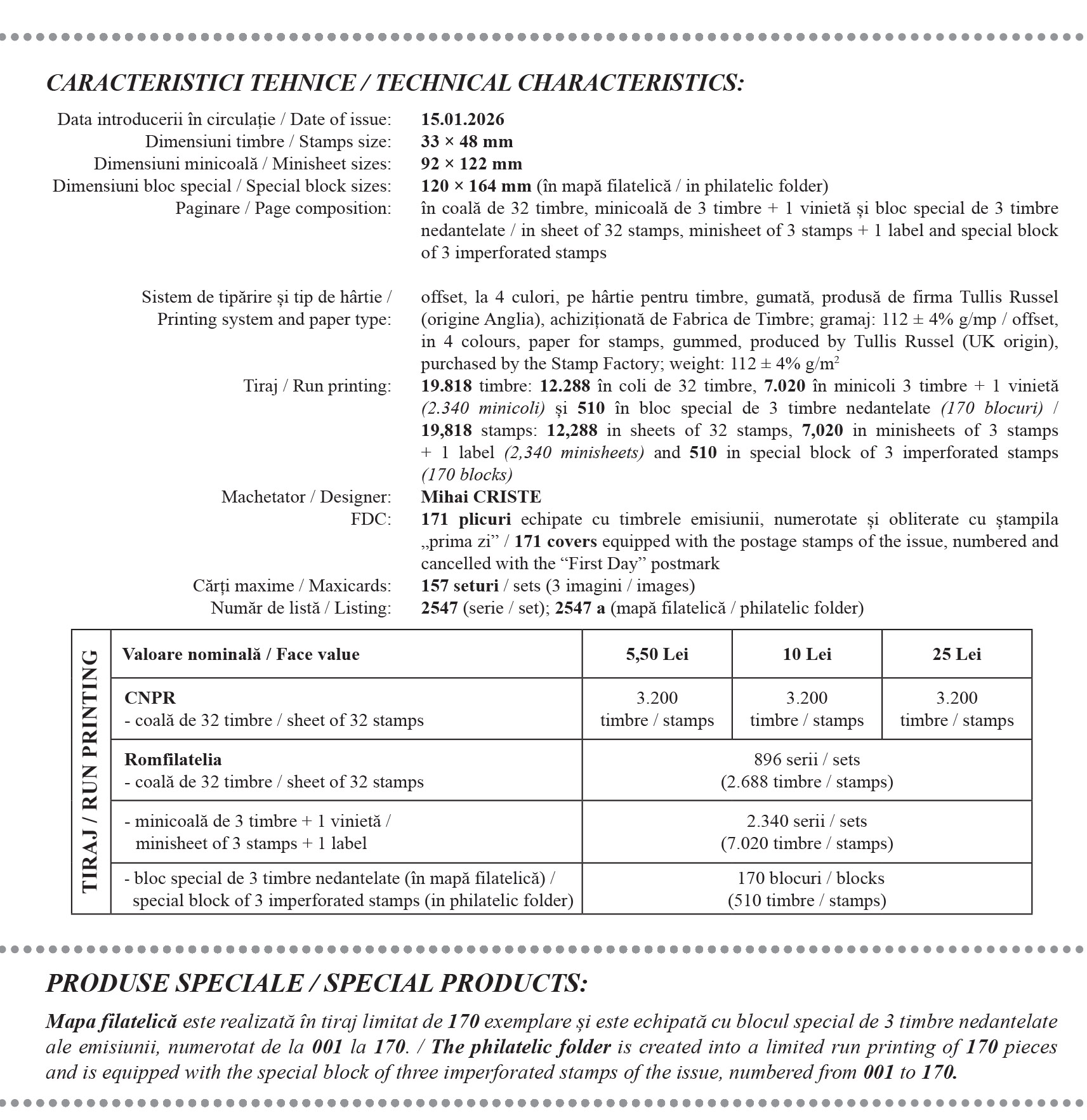
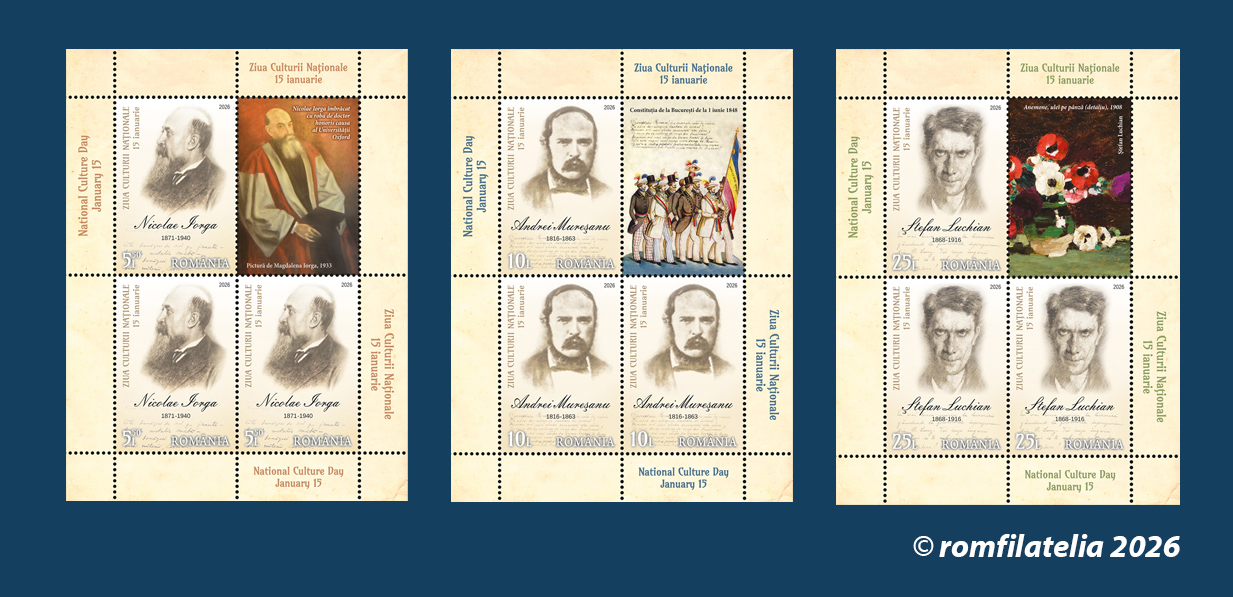
 As every year, on January 15th, the Romanian stamp celebrates National Culture Day, within the issue with the same title, which pays tribute to some outstanding personalities of national culture: Nicolae Iorga (face value of Lei 5.50), Andrei Mureșanu (face value of Lei 10) and Ștefan Luchian (face value of Lei 25).
This year’s issue, consisting of 3 postage stamps, a First Day Cover, a set of 3 maxicards for maximaphily enthusiasts and a philatelic folder with a special product in limited run printing, will be introduced into circulation by Romfilatelia and the Romanian Post on Thursday, January 15.
Andrei Mureșanu (1816-1863), a Greek-Catholic priest, author of the national anthem ‘Deșteaptă-te, Române’ (Awaken thee, Romanian!), whose birth marks the 210th anniversary this year, is ranked among the foremost personalities of the country.
He was born in Bistrița on November 16th, 1816, as the son of Toader and Eftimia, and completed his early studies at the German school and at the Piarist (Catholic) High School in Bistrița. He went on to continue his education at the Greek-Catholic Seminary in Blaj, studying philosophy and theology, having as teachers from 1832 onward Timotei Cipariu, the father of Romanian philology, and Simion Bărnuțiu, President of the Romanian Revolutionary Committee in Transylvania.
George Barițiu, who later became President of the Romanian Academy, founded in Brașov the first Romanian-language newspaper in Transylvania, ‘Foaie pentru minte, inimă
și literatură’ (Leaflet for Mind, Heart, and Literature). A close colleague of Andrei Mureșanu in Blaj, he called him to Brașov in 1838 to serve as a teacher at the Romanian school, which was headed by George Barițiu himself. He then worked in Brașov as a secondary school teacher until 1848.
After the Revolution of 1848–1849, he moved to Muntenia together with George Barițiu. He later returned to Transylvania, settling in Sibiu, where he worked as a civil servant and translator for the government’s official gazette.
In his poetry, Andrei Mureșanu wrote under the allegorical influence of the Văcărești poets, yet his ‘Deșteaptă-te, Române’ (Awaken thee, Romanian!) remains immortal, a true popular anthem, sung during the great trials of the Romanian people, such as the War of Independence and World War I, and revived after the events of December 1989.
This popular anthem expresses, to the highest degree, the ideas of national solidarity, belonging to the Latin heritage, and national nobility, which led, after the events of December 1989, to its adoption as the national anthem, as stipulated by the Romanian Constitution of 2003, which enshrined in Article 12 that ‘The national anthem of Romania is Deșteaptă-te, Române’.
Nicolae Iorga (1871-1940), whose 155th birthday is being celebrated this year, was a historian, literary critic, documentalist and encyclopaedist, and remains a leading personality in Romania and an academic figure unanimously recognized by Europe’s cultural elite.
In Romanian culture in the early decades of the 20th century, Iorga played ‘the role of Voltaire’ (George Călinescu). Gifted with an exceptional intellect, he studied at universities in Paris, Berlin and Leipzig, obtaining his doctorate in 1893 at the age of 23. From 1910, he was an honorary member of the Romanian Academy. He had an exceptional scientific career, authoring 1,003 volumes and over 12,000 articles and studies, culminating in the 10-volume History of the Romanians, for which he was named the greatest historian and scholar of Romania of all time.
Nicolae Iorga was a personality who created a school and gave substance to national culture, strongly influencing the social and political life of the country, expressing himself as a prolific creator both in writing and in speech.
Ștefan Luchian (1868 – 1916), whose commemoration marks 110 years, was born on February 1st, 1868, in Ștefănești, in northern Moldavia.
Ștefan Luchian enrolled in the painting class at the National School of Fine Arts in Bucharest in 1885, graduating four years later and receiving the bronze medal for Head of Expression and Study from Nature.
He then continued his studies in Munich at the Academy of Fine Arts, and later in Paris at the Académie Julian.
He returned to Bucharest in 1896, where, together with Alexandru Bogdan-Pitești, he initiated the Exhibition of Independent Artists. In 1900, he was in Paris at the Universal Exhibition, where he exhibited two pastels.
Due to an incurable illness, from 1909 until his death in 1916, he was confined to a wheelchair.
His paintings capture the splendor of the Romanian landscape with unmatched mastery, reflecting his boundless passion for nature.
Romfilatelia thanks its institutional partners – the Ministry of Culture, the Romanian Academy, the Library of the Romanian Academy, the National Museum of Art of Romania, the National Museum of Romanian Literature, the Brașov County History Museum, and the “Nicolae Iorga” Museum in Vălenii de Munte, section of the Prahova County Museum of History and Archaeology – for their wonderful collaboration and documentary support in the development of this postage stamp issue.