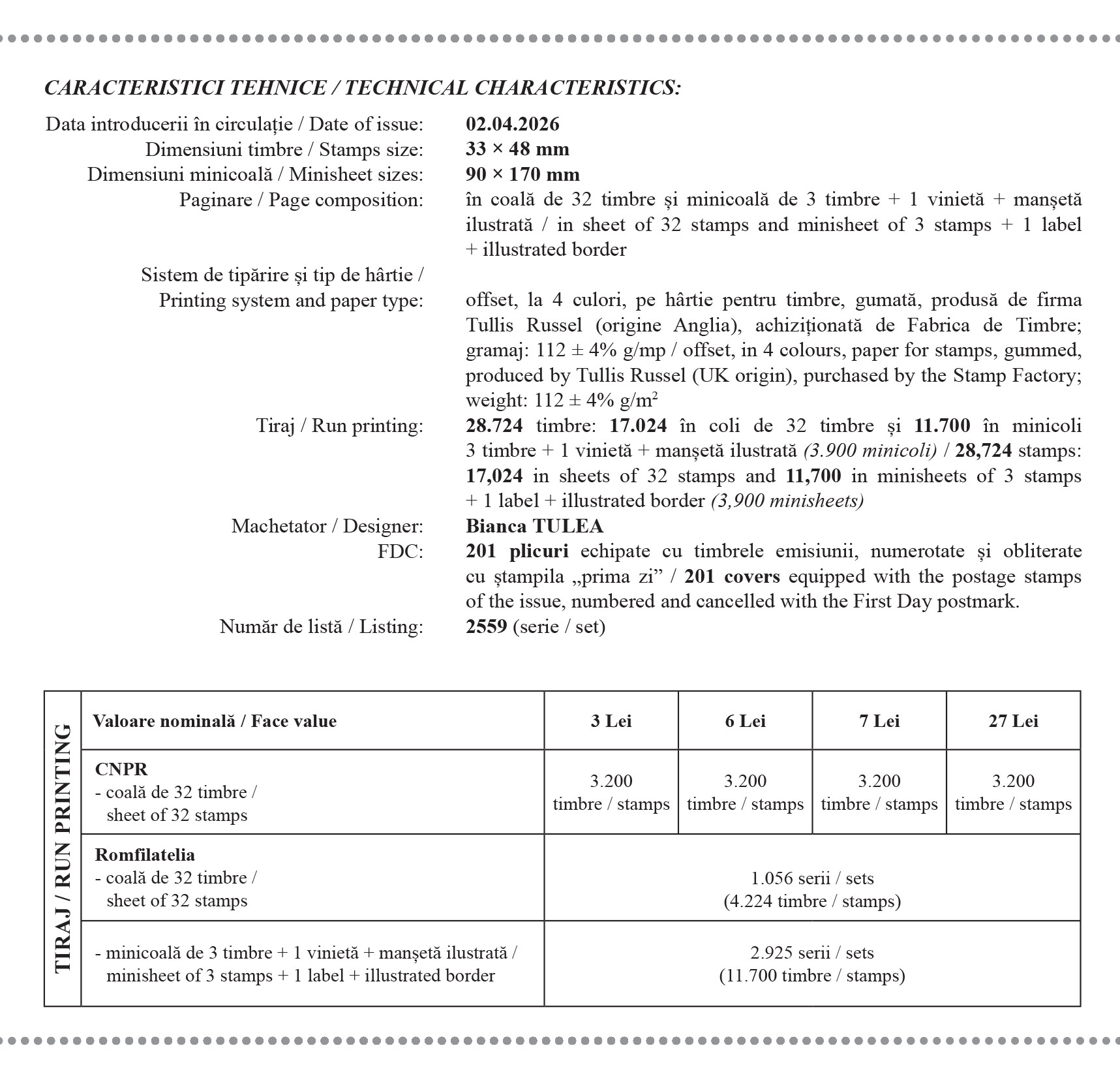
 Romfilatelia and the Romanian Post introduce into circulation on Thursday, April 2nd this year a postage stamp issue dedicated to a cultural event of global significance: International Children’s Book Day, consisting of four postage stamps and a First Day Cover.
This cultural event was initiated on April 2nd, 1967, as a mark of particular respect for the most renowned storyteller for children, Hans Christian Andersen (born on April 2nd, 1885), author of such timeless tales as: The Little Mermaid, The Ugly Duckling, The Snow Queen.
International Children’s Book Day represents a particularly fitting and well-chosen opportunity to highlight the importance of reading in the harmonious development of children.
Stories are meant to spark the imagination, build vocabulary, and guide children as they discover and understand the world around them. Reading stories fosters empathy and provides children with moral guidelines and inspiring role models that are easy to adapt and build upon.
In an age fully immersed in the digital era, in which screen images occupy children’s leisure time, this day reminds us of the joy of reading, of the charm of stories read before bedtime, and of the value of printed books.
By bringing children into the world of books and the habit of reading, we are helping to shape generations that are more eager to learn and more creative, bearing in mind that every book serves as a bridge between generations, fostering moments of connection and shared learning.
The golden age of children’s books is placed in the twentieth century, when illustrated books such as the most well-known ones appeared, highlighting here the most beloved and widely read children’s books, among which are: The Little Prince, by Antoine de Saint-Exupéry, Harry Potter, by J.K. Rowling, The Adventures of Tom Sawyer, by Mark Twain, Alice in Wonderland, by Lewis Carroll, Winnie-the-Pooh, by A.A. Milne, Matilda, by Roald Dahl, The Jungle Book, by Rudyard Kipling.
International Children’s and Young People’s Book Day takes on a special sensitivity, and may be likened to the care of a reserve filled with hidden and rare treasures.
It is often said that the time of childhood is made of candy floss on a stick, doughnuts, swinging, laughter and good cheer, and above all, of stories read or told in a gentle voice by beloved grandparents. All the activities organised on this celebrated day should take the form of shared libraries, where both adults and children read and discuss together, from tales of fantastical animals and adventures to fairy tales filled with tenderness and love. stories like warm, fluffy embraces, like doughnuts dusted with sugar.
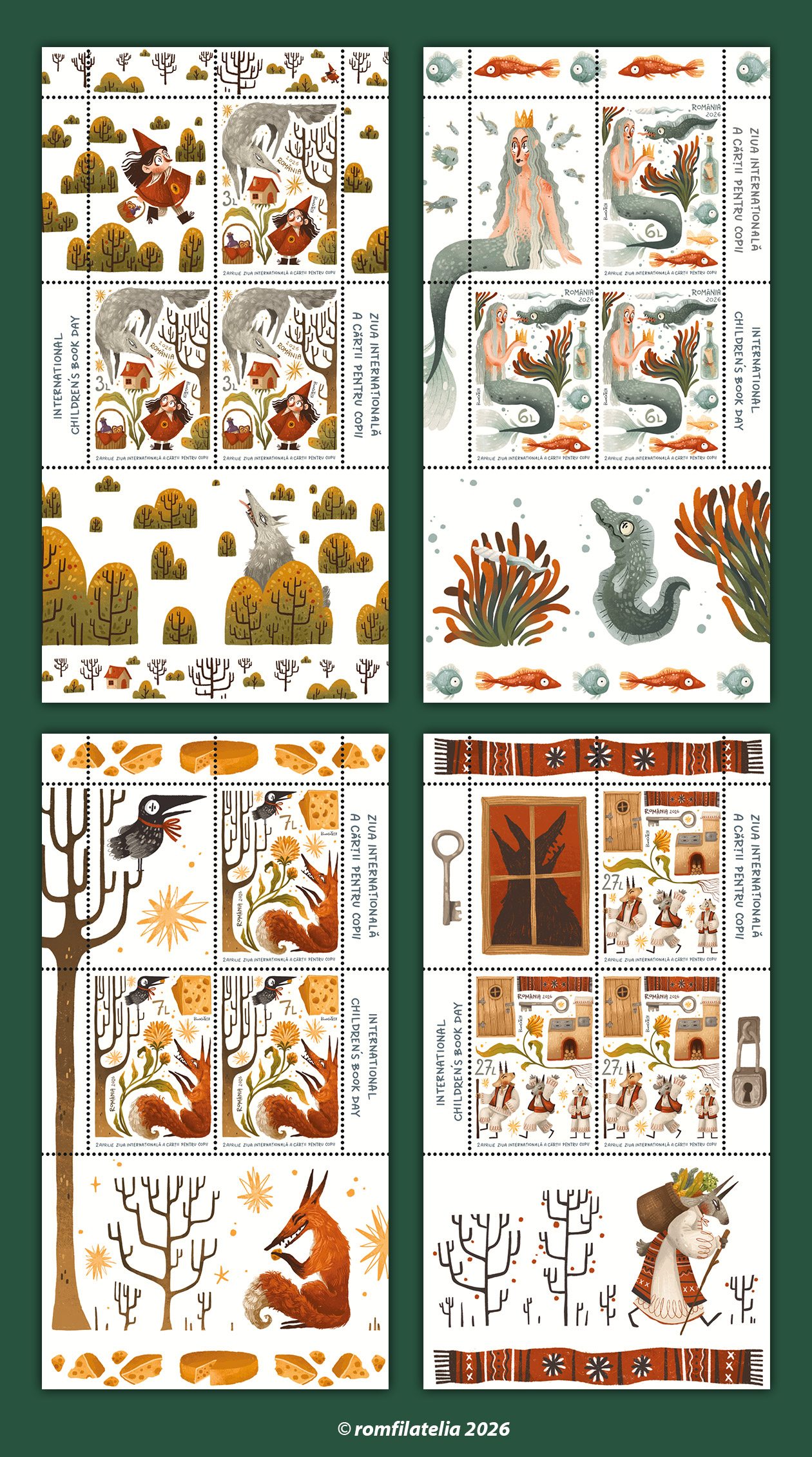
The postage stamp with the face value of Lei 3 illustrates a well-known tale ‘Little Red Riding Hood’. It was collected by folklorist Charles Perrault and by the Brothers Grimm, who made it famous. The story conveys a moral about interactions with strangers, which can lead to serious consequences. The wolf, following Little Red Riding Hood on er way to her grandmother’s house, and the basket of groceries, the real purpose of the journey, appear in the image as defining elements of the tale.
The postage stamp with a face value of Lei 6 depicts a touching story entitled ‘The Little Mermaid’ by Danish writer Hans Christian Andersen.
The witch and defining elements of the drama – the crown, the message in the bottle, the dagger (a symbol of the final sacrifice) – illustrate the fate of the delicate mermaid, who is ultimately transformed into sea foam.
The postage stamp with the face value of Lei 7 depicts the fable ‘The Raven and the Fox’ by Aesop, adapted and made known to the general public by the French writer Jean de La Fontaine. It is a classic fable about how flattery can take advantage of naivety. Flattered by praise, the raven opens its beak and drops the piece of cheese, also illustrating the proverb ‘Sweet words go a long way’.
The postage stamp with the face value of Lei 27 illustrates the famous story ‘The Goat and Her Three Kids’, by the beloved Romanian writer Ion Creangă.The three kids, the well-behaved youngest and the other two careless ones, have as a secondary plan key elements of the story: the door, the key, the lock, the oven and the chimney behind which the youngest kid took refuge, escaping the murderous wolf. The woven carpet subtly alludes to the local origin of the story.
The image on the First Day Cover suggests the idea of staging a small theatrical performance, in which children, playing the roles of the story’s characters, read a single book while sharing their own experiences with the actions of a cunning animal: the wolf.
Romfilatelia thanks the representatives of the Illustrators’ Club for their collaboration, Bianca Tulea, the designer of the issue, being a member of this Club.