 ‘Brâncuși is one of the greatest
creators of all time.’ (Jean Cassou)
‘Brâncuși was the one who gave our era the
consciousness of pure form.’ (Henry Moore)
The year 2026 was officially designated as the ‘Year of Constantin Brâncuși’ by the Law no. 140/2025, promulgated on July 24th, 2025, by the President of Romania, Nicușor Dan.
Romfilatelia and the Romanian Post pay tribute to the great sculptor by dedicating to him an issue of postage stamps entitled Constantin Brâncuși, 150 Years Since Birth, which will be introduced into circulation on Thursday, February 19th this year, the date marking the artist’s birth.
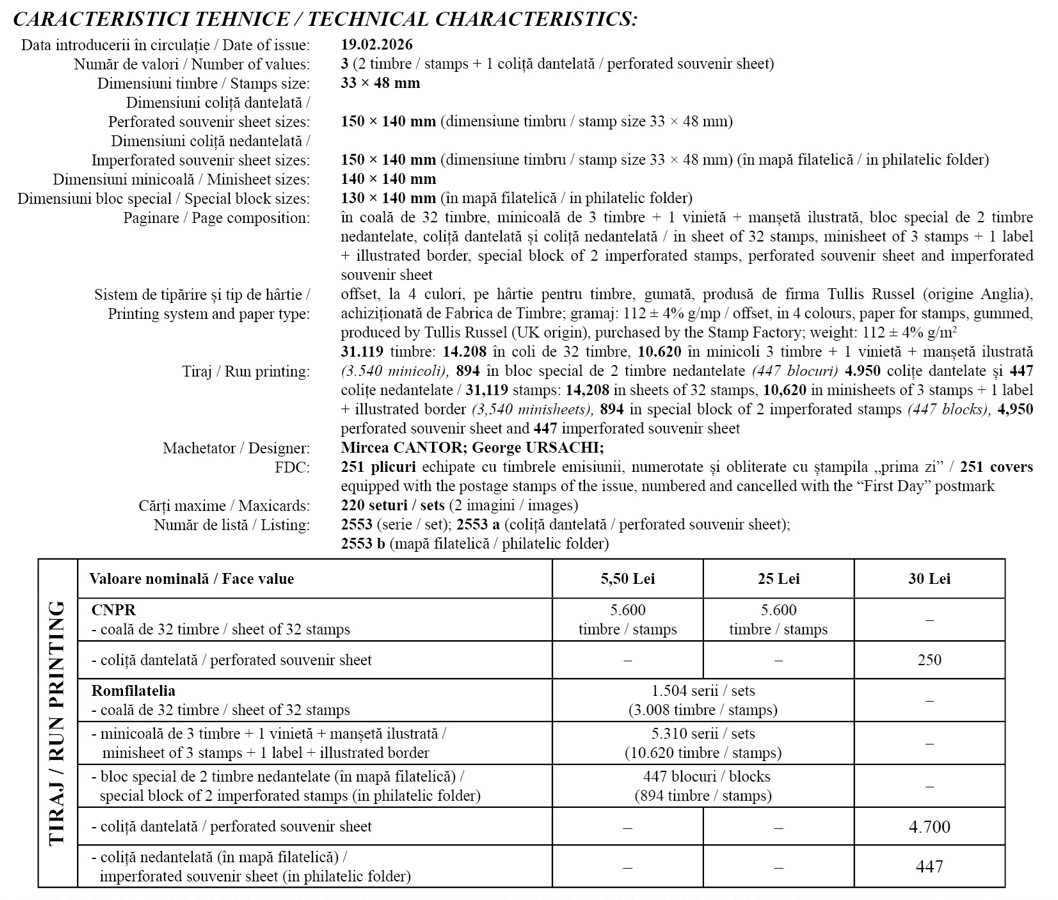
The issue consists of two postage stamps, one perforated souvenir sheet, one First Day Cover, two maxicards for philately enthusiasts, and a philatelic folder with a special product in a limited run printing.
Constantin Brâncuși, born on February 19th, 1876, in Hobița, Gorj County, is regarded as one of the greatest sculptors of the 20th century and a pioneer of modern art.
After completing his studies in Craiova and Bucharest, the artist settled in Paris, where he created works fundamental to modern sculpture, such as The Kiss, The Table of Silence, Sleeping Muse, Bird in Space, and The Endless Column.
In 1907, he agreed to work in Rodin’s studio, which he left shortly thereafter, proud but full of confidence. He later said of Rodin: ‘Nothing grows in the shadow of great trees’.
His work, inspired by Romanian folk art and the European avant-garde, redefined the visual language of the last century, and Brâncuși was posthumously elected a member of the Romanian Academy in 1990.
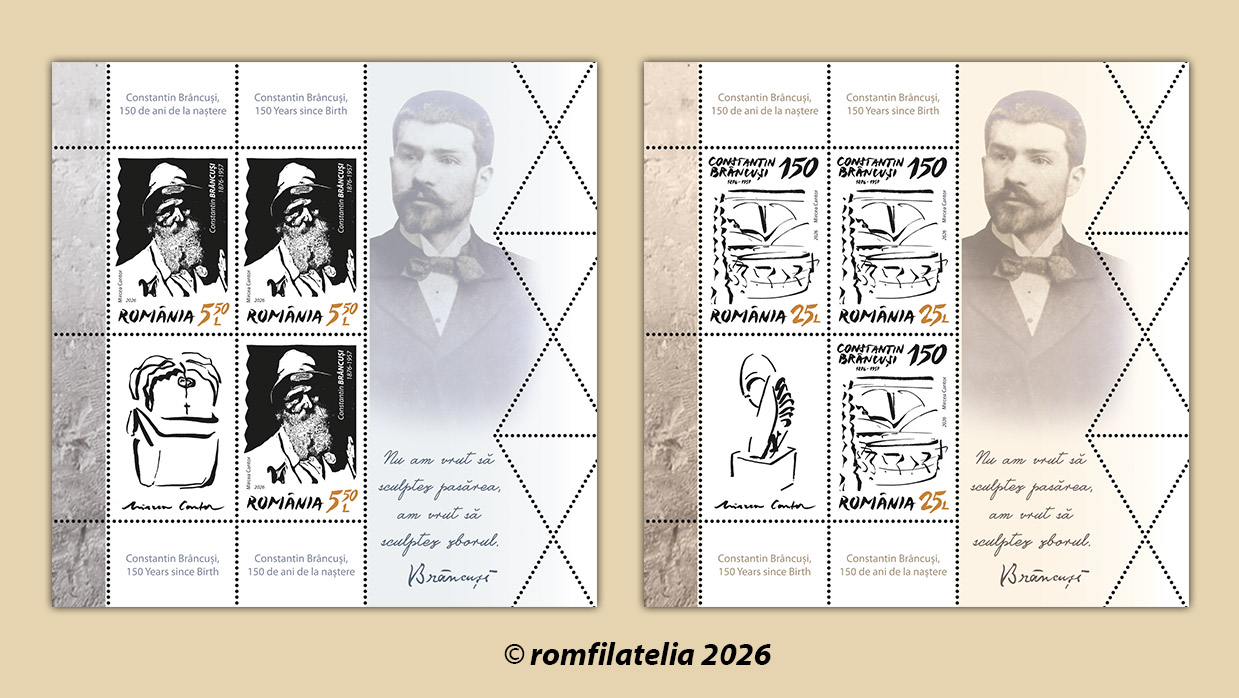
The title Constantin BRÂNCUȘI 150 – just as Brâncuși constantly strove for essence and the essential, so too did the author of the drawings think that Brâncuși’s name, together with the beautiful round number 150, should be the only elements marking the anniversary.
The most spectacular element of the issue is the philatelic souvenir sheet, whose centrally positioned stamp, with a face value of Lei 30, features a portrait of Constantin Brâncuși executed in the linocut technique, created by the artist Mircea Cantor.
Most of the elements surrounding the portrait on the souvenir sheet are closely connected to Brâncuși: sculptures, his studio, and compositional details that converge to highlight the significance of the anniversary date, forming a kind of extended portrait in which one does not see only who Brâncuși was, but above all, what he created.
Obviously, Brâncuși’s magnum opus is undoubtedly The Endless Column. From the funerary pillar to the axis mundi mentioned by Mircea Eliade, this ‘endless pillar’ or ‘string of beads reaching toward the sky’ stands as his most emblematic work, engraved in the consciousness of humanity as an enduring seal of immortality and of the upward striving that transcends time and space.
Brâncuși was born under the sign of Pisces; hence the stylized representation of The Fish. Brâncuși was attentive to the cycles and elements of nature: plants, animals, rocks etc. Also rendered in stylized form are the sculptures The Rooster and The Newborn, right next to his name. The Newborn is one of the most enigmatic and luminously beautiful sculptures from his early period. The rooster, a solar animal, is present on almost all churches in his adopted France – about which he once said: ‘The rooster is me’. The Sleeping Muse, together with Prayer, Mademoiselle Pogany, Danaïde, Portrait of Mrs. Meyer, Princess X and others, are all part of the suite of female figures that marked both Brâncuși’s artistic work and his life.
His Studio, regarded as the most sacred of spaces, was the place where these works were ‘born’ and carefully brought into being. In this Studio, where not everyone was admitted, and where all the household objects were crafted by his own hand, refined through his training at the School of Arts and Crafts in Craiova and the Schools of Fine Arts in Bucharest and Paris, he worked, slept, and hosted gatherings for friends from the Parisian world: artists, intellectuals, and collectors who had come from afar (from America, India).
The two postage stamps of the issue have the face values of Lei 5.50 and Lei 25. One depicts his portrait, as featured on the souvenir sheet, for the same reasons outlined above. The other postage stamp is a stylized drawing that incorporates the three elements of the ensemble in Târgu Jiu: The Table of Silence, The Gate of the Kiss, and The Endless Column. This is the first modern monumental ensemble in the world, a visionary work for its time (the official inauguration took place in 1938).
The recognition of the value of his work was achieved during his lifetime, through the presence of his works in major modern art galleries, as well as the inclusion of the Monumental Ensemble of Târgu Jiu, on July 27, 2024, in the UNESCO list of World Heritage Sites.
The First Day Cover of the issue features a portrait of Constantin Brâncuși at the age of 28.
For us today, it feels natural to see it there and to know it as part of our cultural landscape; however, the historical context of that moment must be taken into account. What a daring work Brâncuși created at that time! To fully understand this, one must look comparatively at other monuments from the same period, created by artists commissioned for various projects. And then we realize with a sense of astonishment the scale, vision, and genius of this unique ensemble in the world, which we are proud to have in our country!
During his lifetime, and also after his death in 1957 in Paris, Brâncuși’s art became an example of the great syntheses of the universe and, at the same time, a quintessence of the profound meanings of the national tradition.
The issue was created based on the original works belonging to the renowned artist Mircea Cantor.
Mircea Cantor was born in 1977 in Oradea, Romania, and currently lives in France. He is a painter, sculptor, draughtsman, director, representative of the conceptual avant-garde, and a creator who conveys his messages through a wide range of artistic media. This is the third time the artist has collaborated on the creation of a series of Romanian postage stamp issue.
Romfilatelia thanks the representatives of the Romanian Academy Library for their documentary support in the development of this postage stamp issue.