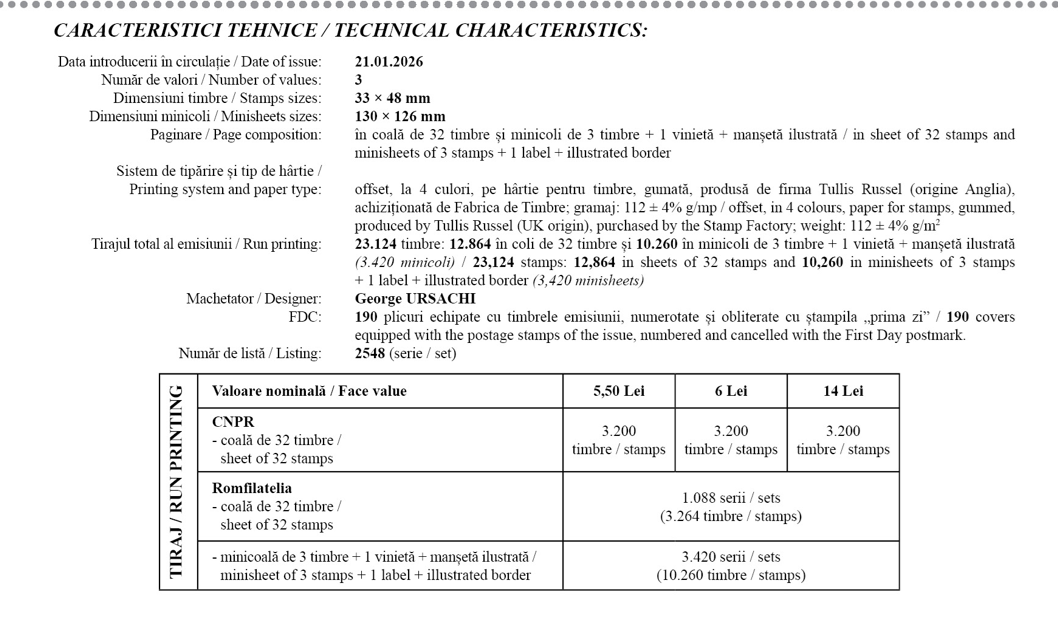
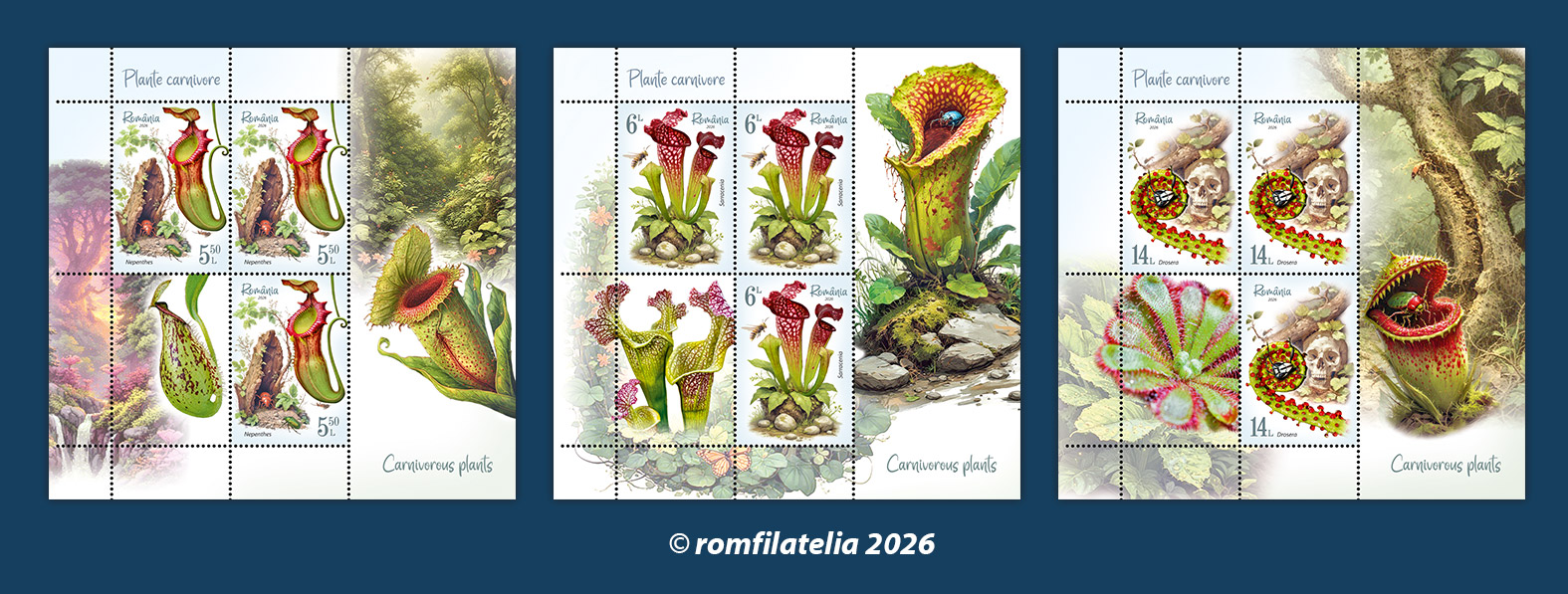
 An interesting issue, with the topic Flora, will be introduced into circulation by Romfilatelia and the Romanian Post on Wednesday, January 21st, this year, under the title Carnivorous Plants, consisting of three postage stamps and a First Day Cover.
These plants arouse the admiration of all observers. The carefully designed mechanisms for capturing prey and its subsequent ‘digestion’ are a fascinating spectacle. Not only the digestive process itself is of interest in carnivorous plants, but also their splendid flowers.
The concept of the issue is approached from two perspectives: the plant itself, depicted realistically, and, as a background, a stylized landscape ensemble, spectacular and rich in sinuous forms.
Nepenthes (face value of Lei 5.50) is the only genus of the family Nepenthaceae and comprises approximately 150 insectivorous species, with a native distribution in Southeast Asia, Australia, and Madagascar. The leaves have evolved specialized traps for capturing insects, the traps consisting of an approximately cylindrical pitcher and an operculum (lid). Insects are attracted by the bright colours of the pitchers, as well as by the nectar present along their rims and on the operculum.
Some are adapted to obtain nutrients from the excrement of certain mammals (such as rodents and bats), which are attracted by the nectar produced on the operculum.
Sarracenia (face value of Lei 6) is one of the genera of the family Sarraceniaceae, comprising 34 herbaceous species distributed in the marshes of temperate and tropical regions of the northeastern South America, western and eastern North America. The basal leaves are transformed into tubular pitchers filled with digestive fluid, with hairs directed toward the base to prevent insects that enter the pitcher from escaping.
Also called the pitcher plant is a remarkable ornamental appeal due to its vividly coloured, pitcher-shaped traps.
Drosera or ‘sundews’ (face value of Lei 14) belongs to the family Droseraceae which comprises three genera and 130 species. Plants are, with few exceptions, small in size and have leaves arranged in a basal rosette, adapted for insectivorous nutrition. These leaves are covered with glandular hairs that are sticky and sensitive to movement. The more a prey struggles to escape, the more glandular hairs are stimulated to become active. In this way, insects searching for food become easy victims.
Drosera has species distributed worldwide, but the greatest diversity is found in Australia. In Romania, the best known is Drosera rotundifolia (sundews). Drosera grows in peat bogs and oligotrophic marshes, habitats that are extremely sensitive to human impact and climate change, and are therefore largely designated as protected areas.
The First Day Cover of the issue features the carnivorous plant Dionaea muscipula.
Dionaea muscipula is also popularly known as Venus flytrap or Steel trap and is the most famous for the speed with which it closes its trap. The plant grows naturally in the marshy areas along the northeastern coast of North America (North Carolina and South Carolina).
Romfilatelia thanks Prof. Paulina Anastasiu, PhD, Director of the ‘Dimitrie Brandza’ Botanical Garden of the University of Bucharest, for the documentary support provided in the development of this postage stamp issue.